THE POSTS MOSTLY BY GEOGRAPHICAL DISTRIBUTION

THE POSTS MOSTLY BY GEOGRAPHICAL DISTRIBUTION

THE POSTS MOSTLY BY GEOGRAPHICAL DISTRIBUTION

.

.
Boston artist Steve Mills - realistic painting
Showing posts with label FRANCE. Show all posts

Friday, May 12, 2017

Bruce Thornton : The Globalist Empire Strikes Back in France

The Globalist Empire Strikes Back in France

The progressive elite breathes a sigh of relief.


Bruce Thornton is a Shillman Journalism Fellow at the David Horowitz Center.


The progressive global elite is breathing a sigh of relief after “centrist” newcomer to electoral politics, Emmanuel Macron, defeated Marine Le Pen to become the next president of France. After the shocks of last year’s Brexit and the election of populist Donald Trump as president, the rejection of populist, nationalist, and anti-EU parties in Austria, the Netherlands, and now the second most important EU country suggests the tide has turned.

But the Eurocrats and Europhiles shouldn’t start popping champagne corks yet. Like all of Europe, France’s problems run deep
.
Macron is the consummate establishment insider, with the youth, pleasing personality, and “hope and change” rhetoric of Barack Obama, who endorsed him because he represents, as Obama said, “the values that we care so much about.” He is the opposite of the fiery, true political outsider Le Pen, who is nearing 50 and focuses on the gloomy problems of immigration and terrorism, and has hard things to say about the EU and the Euro.

Macron also got lucky when his first-round opponent in the voting, center-conservative François Fillon, was weakened by a nepotism scandal. Macron’s other opponent, radical socialist Jean-Luc Mélenchon, is too unhinged even for a basically socialist electorate. And the long demonization of Le Pen as an anti-Semitic Petainist throwback and an Islamophobic, racist fascist has made her a political pariah despite her basically socialist and redistributionist policies, and her promise to do something about the immigration and terrorism that so many French people find threatening.

Macron had another advantage: he put forth a seemingly reasonable program for curing France’s economic ills, which are critical: government spending at 57% of GDP, the highest in Europe; a retirement age of 62 and a 35-hour workweek; 3,500 pages of employment regulations; an unemployment rate of nearly 10% (double that for those under 25); a GDP growth rate barely over 1%; public debt at nearly 90% of GDP; an income tax rate topping out at 45%; nine million people living below the poverty line; and welfare spending at nearly 32% of GDP.
Macron promises to tackle the job and growth-killing policies that have created these dismal numbers, but he’s unlikely to have a parliamentary coalition big enough to get such reforms through. Don’t forget, about a third of the French voters cast a “pox on both your houses” vote, either abstaining or casting a blank or spoiled “white ballot.” This suggests a fragile foundation for Macron’s future government.

And if he tries to follow through on his campaign promises, he will likely meet stiff resistance from critics of “neoliberalism,” the epithet in Europe for free-market capitalism. In March 2006, 2.7 million mostly young French people protested against a minor reform of employment law that would allow entry-level workers to be more easily let go. And that was when the president was Jacques Chirac, a socialist who decried “Anglo-Saxon ultraliberalism,” Euro-speak for laissez-faire capitalism.
Ten years later, socialist prime minister Manuel Valls faced nationwide riots and protests, some broken up with tear gas, over other employment reforms, which he had to get passed by invoking special powers and bypassing parliament.
President Macron and his “neoliberal” reforms are unlikely to be any more successful, given the strength of Mélanchon’s support, the disaffection with Macron of a third of French voters, and the French people’s enduring love for their short work-week and generous subsidies.

And one can question whether Macron’s heart will really be in getting France out of its dirigiste doldrums and fulfill his promise to cut government workers, lower the corporate tax rate, and reform employment laws to make it easier to hire and fire workers.
A one-time investment banker and graduate of the two most elite universities in France, the Paris Institute of Political Studies (Sciences Po) and the École nationale d’administration (ENA), he spent two years as Socialist François Hollande’s economic advisor.
In addition, he’s a big fan of the centralized, top-down rule of the EU and it chronic democracy deficit, demanding sanctions on Hungary and Poland for violating EU “values” on immigration when the two countries defended their borders from the hordes of mostly male economic migrants and jihadists invited in by Angela Merkel. In short, an elite member of the establishment unlikely to be a champion of the free-market, regulatory reforms France desperately needs.

Worse yet, Macron’s position on Muslim immigration and home-grown terrorism is delusional. There has been a string of lethal terrorist attacks in France in the last few years. Three Jewish children slaughtered in Toulouse (2012), 12 dead in the Charlie Hebdo attack, four Jews killed in a Kosher grocery store, 130 killed in the Bataclan theater (2015), 86 people run-down by a truck in Nice, followed by the beheading of a priest (2016), and on the eve of the election the murder of one police officer and the serious wounding of two others.
These are just the most spectacular attacks. For years now gangs of Muslim immigrants, many segregated in Muslim “mini-states,” routinely burn thousands of cars, riot and destroy property, and take over public spaces as the police mostly watch. No wonder that almost half of French polled believe more refugees will increase the likelihood of terrorism, and in another poll 61% support a ban on Muslim immigration.

Yet Macron’s comments on Muslim immigrants and terrorism reflect the globalist elite’s chronic refusal to talk honestly about Islam and terror. 
Dr. Guy Millière of the University of Paris, writing for the Gatestone Institute,  has collected a catalogue of Macron’s myopic pronouncements:
he claimed the French presence in Algeria was a “crime against humanity,” promised that France would be “open and welcoming” to immigration from the Arab world and North Africa, pledged to facilitate the construction of mosques in France, and said “French culture does not exist.”  And during the debate with Le Pen, he spoke of “social issues” as the key to understanding home-grown jihadist terror. In short, the same EU suicidal, we-are-the-world multiculturalist dogma that has covered the streets of France in blood, and that is undermining the national identities and liberal political orders of countries across Europe.

Macron’s embrace of the EU elite’s same transnational stateless idealism, suicidal multiculturalism, and technocratic arrogance is likely to feed rather than defang the populist parties, and continue to undermine the civilizational foundations of Europe and the national identities of its countries.

And they will worsen France’s problems. Demography is not on France’s side, as the number of immigrants is increasing faster than the native-born French. Immigrants are also on average younger.
Like other governments across Europe, the French continue to nurse the fantasy that young immigrants will replace the lost workers necessary for paying the taxes that support old-age entitlements. Muslim immigrants, however, are overrepresented in prisons, unemployment statistics, and welfare rolls. They form a large recruiting pool for terrorist organizations like ISIS and al Qaeda, promising more attacks like those in Paris and Nice.

Finally, the French economy is on track for further dislocations caused by slow growth and high levels of unemployment. The expensive and extensive social welfare benefits will grow costlier, leading to more increases in the national debt and higher growth-killing taxes. Most important, the decline of faith and patriotism leaves many French without the will to defend their way of life against a jihadist foe that knows exactly what he believes is worth killing and dying for.
All these trends point to a coming social cataclysm that will either make the populist and nationalist parties more attractive, or lead to further Islamization that destroys French culture, as imagined in Michele Houellebecq’s dystopian novel Submission, a dark but plausible scenario outlining how France could end up a Muslim nation.

The transnational Western elites celebrating the defeat of the “fascist” and “racist” Marine Le Pen are whistling past the graveyard as they stroll to their rich, white enclaves where the costs of their idealism are never paid. Macron is unlikely to save the French economy, and certainly shows no evidence of understanding the threat of jihadist terror and creeping Islamization. A Wall Street Journal columnist called Le Pen’s welfare-state, anti-globalist economic proscriptions an “illusion,” and praised the “reformist” Macron and supporters because they “don’t peddle dangerous illusions.” But illusions about Islam and unassimilated Muslim immigrants of the sort Macron peddles are much more dangerous and deadly.
Macron is not “turning a new page” in French history, as he claimed in his victory speech. The failed statism and bankrupt internationalist idealism will remain unchanged and unreformed until events, the teacher of fools, forces a change.


 http://www.frontpagemag.com/fpm/266675/globalist-empire-strikes-back-france-bruce-thornton#.WRXrVX0CEf8.facebook

Bruce Bawer : What Happened in France? How could Marine Le Pen have lost in a landslide?

What Happened in France?

How could Marine Le Pen have lost in a landslide?

How could Marine Le Pen have lost in a landslide?
Why, after the Brits chose Brexit, and Americans chose Trump, did the Dutch fail Wilders, and the French fail Le Pen?

How could a country that has been hit by several major terrorist attacks in recent years, and that has undergone a more profound social transformation owing to Islamic immigration, vote for business as usual?

Wilders, buoyed by the Brexit and Trump victories, said that 2017 would be a “Year of the Populist.” So far, alas, it's not turning out that way.
Yes, there are positive signs. The Sweden Democrats are on the upswing. And Wilders did gain seats in the Dutch Parliament.

But if you've witnessed the reality of Islamization in cities like Rotterdam and Paris and Stockholm, you may well wonder: what, in heaven's name, will it take for these people to save their own societies, their own freedoms, for their own children and grandchildren?

I'm not the only one who's been obsessing for years over this question. I've yet to see a totally convincing answer to it.
One way of trying to answer it is to look at countries one by one. For example, the Brits and French feel guilty about their imperial histories, and hence find it difficult to rein in the descendants of subject peoples. The Germans feel guilty about their Nazi past – and the Swedes feel guilty about cozying up to Nazis – and thus feel compelled to lay out the welcome mat for, well, just about anybody. The Dutch, similarly, are intensely aware that during the Nazi occupation they helped ship off a larger percentage of their Jews to the death camps than any other Western European country, and feel a deep need to atone.
Postmodernism, of course, is a factor. According to postmodern thinking, no culture is better than any other – and it's racist to say otherwise. No, scratch that – other cultures are, in fact, better than Western culture. Whites, by definition, are oppressors, imperialists, and colonialists, while “people of color” are victims.
And Muslims are the biggest victims of all.

Not that that makes any sense. Over the centuries since the religion was founded, Muslim armies have gained control over much of north Africa, the Middle East, and large parts of Europe. Islam itself, by definition, is imperialistic. And whenever Islam has conquered non-Islamic territories, it has proven itself to be profoundly oppressive, offering infidels exactly three options: death, subordination, or conversion. But to say these things has become verboten.

Living in a Muslim neighborhood of Amsterdam in early 1999, I read up on Islam and realized very quickly what Europe was up against. Two and a half years later, when the terrorist attacks of 9/11 occurred, I assumed pretty much everyone else would get it, too.

But it didn't work that way. Yes, some people did get it almost instantaneously, in both America and Europe. They caught up on a lot of reading, did a great deal of soul-searching, and underwent a major philosophical metamorphosis.

But even after other horrific attacks occurred – in Madrid, London, and elsewhere – a lot of people refused to accept the plain truth. The plainer the truth got, in fact, the more fiercely they resisted it. And as skilled propagandists began to represent Muslims as the mother of all victim groups, many Westerners were quick to buy into it all.

How, again, to make sense of this?
Yes, the mainstream media have played a role, routinely whitewashing Islam, soft-pedaling the Islamic roots of jihadist terror, and staying silent about the dire reality of everyday Islamization. But no one who actually lives in western Europe has any excuse for ignorance about these matters. The truth is all around them. Even in the remotest places, however dishonest the mainstream media, the truth can be found on the Internet.

But – and this is a fact that some of us are thoroughly incapable of identifying with, and thus almost thoroughly incapable of grasping – some people don't want to know the truth. And if they do know the truth, they want to un-know it.
Orwell understood. He called it doublethink. You can know something and yet can will yourself not to know it. And thereby give free rein to totalitarianism.
For those of us to whom the truth matters, and who wouldn't be able to live with ourselves if we didn't face the truth, however difficult, and try to act responsibly on it, it can be hard to conceive that not everything thinks about these things in the same way that we do.

And I'm not talking about people who are just plain obviously rotten through and through. I'm taking about people who, in everyday life, come across as thoroughly good and decent – but who, when push comes to shove, just don't want to rock the boat. That's a lot of people. Maybe most. People who are nice so long as it's easy to be nice. The sort of people who – if they'd been, say, Christians living in the pre-war Netherlands – would've been the best of friends to their Jewish neighbors next door; but who, when those neighbors came to them and begged to be hidden from the Gestapo, would've refused.

No, come to think of it, you don't even have to take it to the point where the Gestapo is on your tail. There are kind people who, the minute there's any hint of trouble – which means, way before the death-camp round-up begins – prefer to lie low. Their highest value isn't truth or virtue or beauty or even long-term security for them and their families but the ability to buy another day without major trouble.
You'd think they'd be able to look forward at least some distance into the future and dwell on that grim prospect. Able to see their children, their grandchildren, and so forth, living under sharia law. If, indeed, lucky to be living at all.

But I think it needs to be recognized that for some people, seeing that far into the future is just beyond their intellectual grasp. Or beyond what they dare to envision.
Yes, they see Islam taking over. Bit by bit, here and there. Everything in their lives, everything familiar to them, is being transformed, in some cases at a terrifying pace. Perhaps their own lives haven't been turned upside down – yet. But they know people who have suffered greatly because of these changes.

Yet they're terrified to speak up about it, let alone do anything about it. Viewed through American eyes, it may seem a European thing (although it's not as uncommon in America, alas, as it used to be).

Part of what I'm saying is that these people don't have much of a sense of ownership in their own countries, their own communities. They're used to being ruled over. They're used to the idea that there are people above them in the hierarchy whose job it is to think about, and take care of, the big things while they – the citizens, the mice – take care of their own little lives.

Over and over again, they've been given the message, explicitly or implicitly, that their countries don't belong to them – the whole thing about democracy to the contrary – and that to assert any sense of ownership in any way would be a manifestation of the worst kind of bigotry.

You might think that, once in the voting booth, these people would be able – and not just able but eager, desperate even – to stand up against the powers above them that have turned their countries upside down and assert their power as citizens. But everything around them has conspired all their lives to render them incapable of feeling that power – or, perhaps, has rendered them incapable of feeling that they have the moral right to exercise that power in the way that their gut is begging them to.
That still, quiet voice in their heads, which I would describe as a voice of plain reason and common sense, is up against the resounding voices of all the higher-ups shouting in unison – the leading voices of politics, business, the academia, the media, and so on – that they've been bred from infancy to respect and take seriously. To, indeed, obey.

In America we're taught (or, at least, used to be taught) that our leaders work for us; we learn (or used to) that it's not only our right but our duty as individuals to stand up to those leaders when we think they're wrong – especially when we think they're exceeding their powers and infringing on our rights. But Europeans aren't brought up that way. Not really. Yes, there's lip service to the idea of freedom. But when it comes right down to it, they're raised to bow down to the state – to prioritize not themselves, not the individual, but the society, the commonweal, that abstract ideal known as “solidarity.”

So it is that even in a secret ballot, it takes European voters a remarkable amount of nerve to resist the thunderous chorus of voices from above urging them to vote against their own interests; it feels like nothing less than an act of treason to heed the meek little voices in their own heads begging them to do the opposite – to do what's actually best for themselves and their loved ones. They've been psychologically manipulated to the point where they truly believe, on some level, at least in some Orwellian doublethink kind of way, that acting in clear defense of their own existence, their own culture, their own values, and their own posterity, is an act of ugly prejudice.

These, for what it's worth, are the places my mind has wandered since the vote from France came in. At this point I've lived in Europe for just short of twenty years, and have spent every day of that time observing Europeans and trying to understand what makes them tick when it comes to such matters. It helps to be an outsider, even after you've been an outsider so long that you're not really an outsider any more. Frankly, Le Pen's devastating loss doesn't really surprise me. But I still can't say that I get it.


Thursday, May 4, 2017

Guy Millière : French Elections: Emmanuel Macron, a Disaster


  • Anti-West, anti-Israeli and anti-Jewish diatribes were delivered to enthusiastic crowds of bearded men and veiled women. One hundred and fifty thousand people attended.
  • Emmanuel Macron promised to facilitate the construction of mosques in France. He declared that "French culture does not exist" and that he has "never seen" French art. The risk is high that Macron will disappoint the French even faster than Hollande did.
  • On the evening of the second round of elections, people will party in the chic neighborhoods of Paris and in ministries. In districts where poor people live, cars will be set on fire. For more than a decade, whenever there is a festive evening in France, cars are set on fire in districts where poor people live. Unassimilated migrants have their own traditions.
Paris, Champs Elysees, April 20, 8:50 pm. An Islamic terrorist shoots at a police van. One policeman is killed, another is seriously wounded.
The terrorist tries to escape and shoots again. The policemen kill him. One hour later, the French Ministry of Interior reveals his name and his past. His name is Karim Cheurfi. He is a French Muslim born in an Islamized suburb of France. In 2003, he was sentenced to twenty years in prison for the attempted murder of two policemen. He was released before the end of his sentence. In 2014, he targeted a policeman and was sentenced again. And released again. In March, the police were informed that he was trying to buy military-grade weapons and that he contacted a member of the Islamic State in Syria. An inspector discovered that he had posted messages on jihadist social media networks expressing his willingness to murder policemen. The police searched his home and found several weapons and a GoPro video camera similar to the one terrorists use to film their crimes. The police and members of the French justice system did not think they had sufficient evidence place him under surveillance.
The Champs Elysées attack clearly shows that the French justice system is lax regarding dangerous people and that the French police pay only limited attention to suspects who are communicate with terrorist organizations and who seem to be hatching terrorist projects.
This terrorist attack summarizes everything that is broken in terms of security in France today.
Men with a profile similar to that of Karim Cheurfi have, in recent years, been responsible for most of the terrorist attacks in France and Belgium: Mohamed Merah, who killed three Jewish children and the father of two of them in Toulouse in 2012; Mehdi Nemmouche, who attacked the Brussels Jewish Museum in 2014 ; the Kouachi brothers, who committed the Charlie Hebdo massacre in 2015; Amedy Coulibaly, who murdered four Jews in the Saint Mandé grocery Kosher store Hypercacher; Samy Amimour and others who maimed and murdered 130 innocent people in the Bataclan theater in November 2015; Mohamed Lahouaiej Bouhlel, who drove a truck into the crowd in Nice in July 2016, killed 86 people and wounded many others, and, among others, those who beheaded a priest in Normandy a few weeks after the attack in Nice.
The successive French governments under the presidency of François Hollande showed themselves to be appallingly weak and impotent.
A climate of fear has overtaken the country. Attendance at theaters has declined. The particularly targeted Jewish community -- two-thirds of the attacks in France in the last five years targeted Jews -- feels abandoned. When a Jewish cemetery was vandalized on March 30 in Waldwisse, eastern France, neither the media nor the political leaders reacted. A week later, in Paris, a Jewish woman, Sarah Halimi, was tortured and then thrown out of a window by a non-radicalized Muslim, simply because she was Jewish: the French media and political leaders, with the exception of the courageous MP Meyer Habib, also did not react. A silent gathering below the window was organized by some leaders of the Jewish community. Only Jews came; they were greeted by anti-Semitic insults by Arab Muslims in the neighborhood. The implantation of radical Islam in the country is intensifying. The annual meeting of "Muslims of France" (the new name of the French branch of the Muslim Brotherhood), took place on April 14-17 in Le Bourget, ten miles north of Paris. Anti-West, anti-Israeli and anti-Jewish diatribes were delivered to enthusiastic crowds of bearded men and veiled women. One hundred and fifty thousand people attended.
Economically, France is in terrible shape. The unemployment rate remains above 10%. Nine million people are living below the poverty line --14% of the population. Economic growth is stagnant. Government spending accounts for 57% of GDP -- 13% more than in Germany, France's main economic competitor in Europe.
Month after month, polls shows that the French population is anxious, angry, immensely disappointed with current French policies. François Hollande ends his term with a popularity rating close to zero. He was so rejected and discredited that he decided not to run again for the presidency.
The first round of the French presidential election took place in this context, and one could expect that the French population would reject everything that looks like François Hollande's policies and choose a new direction for the country.
That is not what happened; quite the opposite.
Benoit Hamon, the Socialist Party's candidate, suffered a disastrous blow and received a mere 6% of the vote. Jean-Luc Mélenchon, a far-left candidate who left the Socialist Party a few years ago and who supported Hollande in 2012, received a much higher score: 19% of the vote. He is an admirer of Hugo Chavez, Fidel Castro, and the late Palestinian leader, Yasser Arafat. Immediately after the anti-Semitic Islamic attack in Saint Mandé, he claimed that "Jewish extremism is more dangerous than Islamic extremism". That statement did not hurt him.
Above all, Emmanuel Macron, a candidate close to Hollande won the race and will be elected President on May 7. He was Hollande's senior economic advisor for more than two years, and the main architect of Hollande's failed economic policies. He then became Minister of the Economy, Industry and Digital Affairs, and held that post until he entered the presidential race.

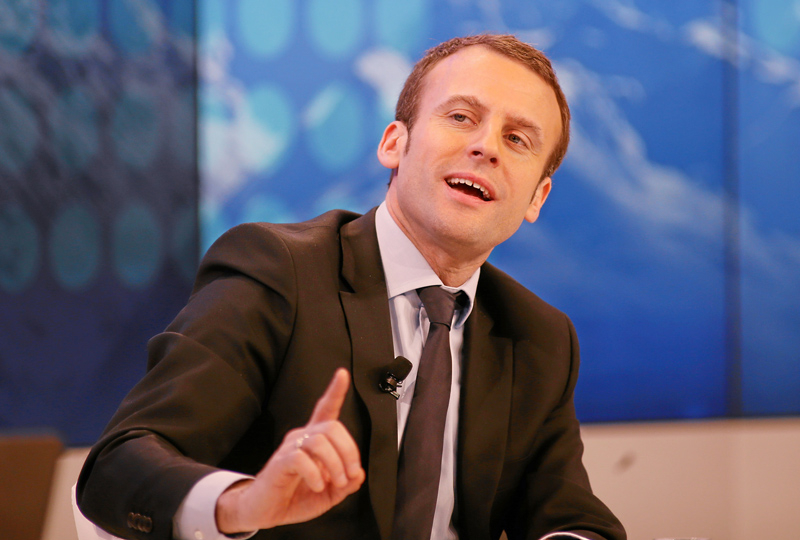
Emmanuel Macron, then Minister of the Economy, Industry and Digital Affairs of France, at the Annual Meeting 2016 of the World Economic Forum in Davos, Switzerland, January 22, 2016. (image source: World Economic Forum/Michele Limina)
Most of Macron's speeches are copies of the speeches Hollande made during his 2012 presidential campaign. What is known of Macron's positions on most subjects show that they are the same position Hollande had during the last months of his mandate.
Throughout the campaign, Macron virtually never spoke about the danger of Islamic terror; when he did, he used words even weaker than those used by Hollande. After the Champs Elysees attack on April 20, he said: "imponderable" events had occured, and they "will be part of the daily life of the French in the years to come". The next day, when asked what he would do to prevent other killings, he said that he could not "devise a plan to fight terrorism overnight".
When he speaks about the economy, he sounds like Hollande: he uses vague terms, such as the need for more "social mobility" and "success for all". He insists that he will maintain all the sclerosis dear to so many, such as the compulsory 35-hour workweek or the legal age for retirement: 62. He said that he would leave the almost-bankrupt retirement system the way it is. He promised additional regulations aimed at "saving the planet" and, in a classically socialist way, tens of billions of euros of government "investments" supposed to finance "ecological transition" and "public services".
Sometimes, he makes remarks so dismaying that even Hollande would not have said them. In Algeria, in the presence of the National Liberation Front representatives, an organization that came to power by terrorism and massacring hundreds of thousands of "harkis" (Algerians who had chosen France), he said that the French presence in Algeria was a "crime against humanity", and later promised to facilitate immigration from the Arab world and from Africa to France by preserving an "open and welcoming" France. He promised to facilitate the construction of mosques in France. He declared that "French culture does not exist " and that he has "never seen" French art.
He quite often has shown that he is a political novice and that it is his first election campaign. He stumbled upon the words of his speeches and admitted to those listening to him that he did not understand the meaning of the sentences he had just read, which showed that he had not read what was written for him before reading it to the public.
How to explain his success in these conditions?
The first explanation lies in the moderate right candidate's elimination. François Fillon had a credible and coherent program for the country's recovery, but he could hardly speak about it. His campaign was quickly engulfed in a fake jobs scandal. He presented himself as an impeccable candidate: he appeared not so impeccable. A book recently published revealed that the scandal was meticulously orchestrated from a "shadow Cabinet" in the Elysee Palace. Fillon was never able to recover from it. His excuses were weak and contradictory. He confirmed his weakness by announcing his unconditional support for Macron immediately after the first round results were published. For the first time in more than fifty years, the moderate right will not have a candidate in the second round of a French presidential election. Showing their own weakness, most of the moderate right leaders followed Fillon example and decided to support Macron.
The second explanation for Emmanuel Macron success lies in a very elaborate communication strategy.
Emmanuel Macron continuously benefited from François Hollande support and most of the last five years socialist ministers, but an allegedly neutral and apolitical political structure was created for him. It was called En marche! ("On the Move!"). The socialist ministers who joined him rallied On the Move!, and remained silent. Francois Hollande only announced his full support very late in the race. The communication strategy could work because Emmanuel Macron received the support of left-wing billionaires whom he helped when he was Minister of Economy, and who have close relations with the powers that be: Pierre Bergé, Xavier Niel and Patrick Drahi. These people also own most France's mainstream media and were able to carry out strong media campaigns in support of Macron. No candidate in the French presidential election history has been on the cover of so many magazines and newspapers. Emmanuel Macron also enjoys main French investment banks support: he is a graduate of the Ecole Nationale d'Administration, which trains all senior civil servants and almost all French politicians since it was established in 1945 and, before joining Francois Hollande, he had a career in a financial institution.
The third explanation for Emmanuel Macron's success is that the communication campaign in his favor has been largely devoid of any political content, just like On the Move. He was presented as a young man, embodying the "future", a "renewal", a "hope", a "change". For most of the campaign, Emmanuel Macron had no program. His program was only published on the internet six weeks before the election. The text is often meaningless. Fear is defined as a "daily anguish". It says that France must offer "opportunities" and Europe must be a "chance". Emmanuel Macron told socialists he is a socialist, then said that he is not a socialist at all when he addressed other audiences. Opinion polls have shown that many of those who voted for him in the first round were unaware of his proposals on any topic.
Those who designed Emmanuel Macron's campaign took a lot of inspiration from Barack Obama's 2008 presidential campaign, and the result shows that they were right.
The result is also very distressing, because it shows that a massive communication campaign can be effective, even if it is full of empty words and seems to considers voters as idiots. Emmanuel Macron's campaign effectiveness is also due to the fact that in France, virtually no media is likely to contradict what is said in the mainstream media: the French economy is a very state-based economy in which creating and sustaining media independence from the government and from government subsidies is almost impossible.
The second round of the French presidential election will take place on May 7. Emmanuel Macron will face the only remaining candidate, populist Marine Le Pen.
During the entire campaign, she was almost the only one to speak clearly about the Islamic terrorist threat (François Fillon did, too, but more discreetly) and to offer credible solutions to fight it. She was the only one to speak of the rise of radical Islam in France and to denounce the Muslim Brotherhood gathering at Le Bourget. She was the only one to stress the increasing perils resulting from uncontrolled immigration, and the risk of French culture disappearing. She was also the only one to mention the demographic change that occurs in France and in Europe because of the new migrants. She was the only one to denounce the Islamic anti-Semitism that relentlessly kills Jews in France. Unfortunately, she has a nearly Marxist economic program, close to that of Jean Luc Melenchon. She is the leader of the National Front, a party founded by her father, an anti-Semite, Jean-Marie Le Pen; although she has excluded her father and virtually all her father's anti-Semitic friends from the National Front, she is nonetheless the party leader and is regarded as her father's daughter.
Marine Le Pen and the National Front will be used as scarecrows to urge voters to rally massively behind Macron, in the name of a "Republican front" against "fascism." The strategy was developed thirty years ago by the French left, under President Francois Mitterrand. It has always worked, and in a few days, it will work again.
Macron now has the support of the entire Socialist party, and the support of virtually all other politicians. He also has the support of all French Muslim organizations. The rector of the Great Mosque of Paris said that Muslims must "massively vote" for him. The Jewish community leaders also rallied on behalf of Macron. On May 7, he will likely get more than 60% of the vote.
Most will not be based on the support for a project; the risk is high that Macron will disappoint the French even faster than Hollande did. The French may quickly discover that he is just a man chosen by the French left to preserve an unsustainable status quo a little longer, and a member of the self-appointed élites who do not care about ordinary people's problems, who consider that terrorist acts are "imponderable events", and who believe that national identities can melt in a no-border globalized world. When the French discover who Macron is, there will be nothing they can do to change what they voted in.
The risk to France in the next five years will probably be painful for the French. According to the Police, more than 12,000 radicalized Muslims live in the country and most of them are not under surveillance. The Police do not have the means to do more than they currently are doing, and Macron does not seem to care. The justice system is in the hands of judges who appear lenient to terrorists, and Macron seems to accept it. The flow of migrants will not stop, and Macron apparently does not intend to do anything about that. More and more, Muslims segregate themselves from French society in expanding Islamist mini-states.
Nothing Macron proposes can reverse the decline of the French economy and French society. Terror attacks will undoubtedly occur. Jews and others will undoubtedly be killed. Riots and discontent will undoubtedly take place.
On the evening of the first round of the election, there were riots in Paris and Nantes. On the evening of the second round of elections, people will party in the chic neighborhoods of Paris and in ministries. In districts where poor people live, cars will be set on fire. For more than a decade, whenever there is a festive evening in France, cars are set on fire in districts where poor people live. Unassimilated migrants have their own traditions.
In the next election, in 2022, Catholic France may well see a Muslim candidate run -- and win.
Dr. Guy Millière, a professor at the University of Paris, is the author of 27 books on France and Europe.

Yves Mamou : France: What is the Presidential Campaign Really About?


  • The result of this mess is that France as one country no longer exists.
  • People who voted for Le Pen seem to feel not only that they lost their jobs, but that they are becoming foreigners in their own country.
  • Macron, for many analysts, is the candidate of the status quo: Islamists are not a problem and reforming the job market will supposedly solve all France's problems.
The French presidential race is the latest election to shake up establishment politics. The Parti Socialiste and Les Républicains, who have been calling the shots for the past forty years, were voted out of the race. The "remainers" are Emmanuel Macron, a clone of Canada's Prime Minster Justin Trudeau; and Marine Le Pen, whom many believe will not win.
France is a fractured country. As in the US and the UK, the rift is not between the traditional left and right. Instead, it reflects divisions -- cultural, social, and economic -- that came with globalization and mass migration. A map released by the Ministry of the Interior after the first round of the presidential campaign illustrates the new political scenery.

Blue represents the parts of France where Le Pen heads the list; pink, the areas supporting Macron. The blue areas coincide with old industrial areas, deeply damaged by globalization and industrial relocation. Many blue-collar workers are on welfare; and the antagonism between Muslims and non-Muslims is high. People who voted for Le Pen seem to feel not only that they lost their jobs, but that they are becoming foreigners in their own country.

The areas in pink (Macron), represent the big cities and places where the better jobs are. It also represents the areas where the "upper classes can afford to raise invisible barriers between themselves and the 'other', immigrants or minorities," explains Christophe Guilluy, geographer, and author of Le crépuscule de la France d'en haut (The Twilight of Elite France).

The result of this mess is that France as one country no longer exists. One half the population (in blue-collar areas, small towns and rural areas) is shut out by the other half of the population (white-collar workers) who live in the big cities.
Guilluy adds:
"The job market has become deeply polarized and mainly concentrated in big cities, squeezing out the middle classes. For the first time in history, working people no longer live in the places where jobs and wealth are created."
...
"But social issues are not the only determinant of the populist vote. Identity is also essential, linked as it is to the emergence of a multicultural society, which feeds anxiety in working-class environments. At a time of fluctuating majorities and minorities, amid demographic instability, the fear of tipping into a minority is creating considerable cultural insecurity in developed countries. Unlike the upper classes, who can afford to raise invisible barriers between themselves and the 'other' (immigrants or minorities), the working classes want a powerful state apparatus to protect them, socially and culturally. So, the populist surge is re-activating a real class vote."
The question is if frustration and anger against globalization and immigration will succeed in electing Le Pen.

This frustration was not made lighter by the abysmal level of the debate. During the presidential campaign, the media focused only on political scandals: the presumed "fake job" offenses committed by François Fillon. Week after week, other presumed "political scandals" were continually released against him by a satirical weekly, Le Canard Enchaîné.
Organized or not, these allegations overtook any discussion about the real problems in France:
 the extraordinary proportion of people on welfare, for instance. France's unemployment rate stands at 9.9% (compared to 3.9% Germany and 4.7% in Great Britain); French GDP growth is one of the weakest of eurozone (1.1% vs 1.7% for eurozone, and 1.9% for EU); and France's public debt, which accounted for 89.5% of GDP in 2012, is expected to reach 96% of GDP in 2017.

Most of all, the "French Islamist problem" remained undebated and unchanged.

 After two years of continuous terrorist attacks, after five years of continuous Muslim immigration, after dozens of Muslim riots, big and small, in the suburbs of big cities, millions of French people were expecting a change -- or at least a public conversation. But, intentionally or not, these questions were avoided by the media.

The expected victory of Emmanuel Macron -- a perfect product of the French techno-sphere -- dashes any hopes of addressing the frightening questions of Muslim immigration; Muslim no-go-zones (more than a hundred); the spread of Salafism among Muslim youths, and of the general secession of the French Muslim community.

Macron, young and modern, cautiously avoided talking about these problems. Macron, for many analysts, is the candidate of the status quo: Islamists are not a problem and reforming the job market will supposedly solve all France's problems.


French presidential candidates Emmanuel Macron (left) and Marine Le Pen. (Image source: LCI video screenshot)

The results of the first round on April 23 showed that roughly 45% of the votes cast were motivated by protest and anger against globalization and dilution of the French nation's sovereignty inside the European Union. The leftist populist Jean-Luc Mélenchon (19% of the voters) refused to endorse Macron in the runoff.
Inside Les Républicains, the big party loser of the first round, no one knows if a significant percentage might turn to Le Pen.

On May 7, more than 228 years after the French Revolution, the destiny of France may be seriously different -- and whatever the result of the presidential election, possibly not for the best.
Yves Mamou is a journalist and author based in France. He worked for two decades for the daily, Le Monde, before his retirement.

Monday, May 1, 2017

1er mai

1941, le Maréchal Philippe Pétain instaure le 1er mai comme « la fête du Travail et de la Concorde sociale »
Le 24 avril 1941, le Maréchal Philippe Pétain instaure officiellement par la loi Belin le 1er mai comme « la fête du Travail et de la Concorde sociale », appliquant ainsi la devise Travail, Famille, Patrie : par son refus à la fois du capitalisme et du socialisme, l’État français recherche une troisième voie fondée sur le corporatisme, débaptisant « la fête des travailleurs » qui faisait référence à la lutte des classes.   Le jour devient férié, chômé et payé.  Le 1er mai coïncide aussi avec la fête du saint patron du maréchal, Saint Philippe.


Patrick J. Buchanan : Is Macron the EU’s Last Best Hope?

Is Macron the EU’s Last Best Hope?


By Patrick J. Buchanan

For the French establishment, Sunday’s presidential election came close to a near-death experience. As the Duke of Wellington said of Waterloo, it was a “damn near-run thing.”
Neither candidate of the two major parties that have ruled France since Charles De Gaulle even made it into the runoff, an astonishing repudiation of France’s national elite.

Marine Le Pen of the National Front ran second with 21.5 percent of the vote. Emmanuel Macron of the new party En Marche! won 23.8 percent.
Macron is a heavy favorite on May 7. The Republicans’ Francois Fillon, who got 20 percent, and the Socialists’ Benoit Hamon, who got less than 7 percent, both have urged their supporters to save France by backing Macron.
Ominously for U.S. ties, 61 percent of French voters chose Le Pen, Fillon or radical Socialist Jean-Luc Melenchon. All favor looser ties to America and repairing relations with Vladimir Putin’s Russia.

Le Pen has a mountain to climb to win, but she is clearly the favorite of the president of Russia, and perhaps of the president of the United States. Last week, Donald Trump volunteered:
“She’s the strongest on borders, and she’s the strongest on what’s been going on in France. … Whoever is the toughest on radical Islamic terrorism, and whoever is the toughest at the borders, will do well in the election.”

As an indicator of historic trends in France, Le Pen seems likely to win twice the 18 percent her father, Jean-Marie Le Pen, won in 2002, when he lost in the runoff to Jacques Chirac.

The campaign between now and May 7, however, could make the Trump-Clinton race look like an altarpiece of democratic decorum.

Not only are the differences between the candidates stark, Le Pen has every incentive to attack to solidify her base and lay down a predicate for the future failure of a Macron government.

And Macron is vulnerable. He won because he is fresh, young, 39, and appealed to French youth as the anti-Le Pen. A personification of Robert Redford in “The Candidate.”
But he has no established party behind him to take over the government, and he is an ex-Rothschild banker in a populist environment where bankers are as welcome as hedge-fund managers at a Bernie Sanders rally.
He is a pro-EU, open-borders transnationalist who welcomes new immigrants and suggests that acts of Islamist terrorism may be the price France must pay for a multiethnic and multicultural society.
Macron was for a year economic minister to President Francois Hollande who has presided over a 10 percent unemployment rate and a growth rate that is among the most anemic in the entire European Union.
He is offering corporate tax cuts and a reduction in the size of a government that consumes 56 percent of GDP, and presents himself as the “president of patriots to face the threat of nationalists.”
His campaign is as much “us vs. them” as Le Pen’s.
And elite enthusiasm for Macron seems less rooted in any anticipation of future greatness than in the desperate hope he can save the French establishment from the dreaded prospect of Marine.
But if Macron is the present, who owns the future?
Across Europe, as in France, center-left and center-right parties that have been on the scene since World War II appear to be emptying out like dying churches. The enthusiasm and energy seem to be in the new parties of left and right, of secessionism and nationalism.
The problem for those who believe the populist movements of Europe have passed their apogee, with losses in Holland, Austria and, soon, France, that the fever has broken, is that the causes of the discontent that spawned these parties are growing stronger.

What are those causes?
A growing desire by peoples everywhere to reclaim their national sovereignty and identity, and remain who they are. And the threats to ethnic and national identity are not receding, but growing.
The tide of refugees from the Middle East and Africa has not abated. Weekly, we read of hundreds drowning in sunken boats that tried to reach Europe. Thousands make it. But the assimilation of Third World peoples in Europe is not proceeding. It seems to have halted.
Second-generation Muslims who have lived all their lives in Europe are turning up among the suicide bombers and terrorists.
Fifteen years ago, al-Qaida seemed confined to Afghanistan. Now it is all over the Middle East, as is ISIS, and calls for Islamists in Europe to murder Europeans inundate social media.
As the numbers of native-born Europeans begin to fall, with their anemic fertility rates, will the aging Europeans become more magnanimous toward destitute newcomers who do not speak the national language or assimilate into the national culture, but consume its benefits?

If a referendum were held across Europe today, asking whether the mass migrations from the former colonies of Africa and the Middle East have on balance made Europe a happier and better place to live in in recent decades, what would that secret ballot reveal?
Does Macron really represent the future of France, or is he perhaps one of the last men of yesterday?


 http://buchanan.org/blog/macron-eus-last-best-hope-126852
===================

Friday, April 28, 2017

Peter Baggins : The French Election: Adieu, la France


The French Election: Adieu, la France

Peter Baggins, Ph.D.


Mainstream media: Macron saving France (depicted as a White woman) by leading her to the glorious future of “openness and diverse modernity”
As anticipated by most observers, liberal globalist Emmanuel Macron and populist nationalist Marine Le Pen were selected by French voters to move on to round two in France’s presidential election, scheduled for May 7th.  For the first time in the 59-year history of the French Fifth Republic neither of the country’s two main parties, the Socialists and the Republicans, made the second round of presidential balloting. Either the socialists or the center right have run France since the 1950s, but with this election the old model has been shattered.
When the two-round system was created, it was expected that the main candidates of right and left would get around 30% in round one, and then rally satellite parties to their side for the run-off. But this time there were four candidates — with four very different versions of what to do next — all split nearly evenly at around 20%, so whoever is elected will be a minority candidate. The latest figures from the French Interior Ministry have Macron at 24%, Le Pen at 21.3%, while conservative François Fillon missed the runoff at 20%, Left-wing Jean-Luc Melenchon at 19.6% and Socialist Benoît Hamon at a paltry 6.4%.
By all accounts Macron, is likely to pick up the most votes in the runoff and will almost certainly become the next president. Marine Le Pen will fight a hard campaign, and her totals will rise, but it is almost inconceivable that she will win, according to the French and International press. Apart from this speculation, what conclusions can be drawn thus far?


First, last Sunday’s vote has shown France to be deeply divided. Four candidates with markedly different views came within a few points of one another in the vote on Sunday, suggesting that the fight about what vision of France will dominate the future is far from over.
Second, many voters are angry at current policies, including economic policies and open borders, which are seen as responsible for an endless series of terrorist attacks. For the first time ever, neither of the top two candidates represents the establishment parties. Le Pen campaigned stridently against Muslim immigration, linking it to security threats, and she may have benefited from a final surge of support after a terrorist attack in Paris two days before the election, the latest in a string of atrocities that have beset France over the past two years.
Third, the socialist left has been left in ruins. Just five years ago the Socialist party of President François Hollande achieved electoral dominance in the National Assembly and Senate as well as the Elysée palace. Benoît Hamon won the January primary vote convincingly, defeating the former prime minister, Manuel Valls but he was completely rejected by the French electorate, attracting just 6.35% of the vote.
Finally, and most importantly, the French have a real choice in the May 7 runoff, as the two remaining candidates present stark alternatives for the future of the French Republic. From an American perspective, it looks a lot like globalist Hillary-Obama squaring off against nationalist Donald Trump.
Nowhere is this stark contrast between the two more apparent than their reactions to the latest act of terrorism on French soil. As reported by The Guardian, Macron, has described terrorism as an  “imponderable problem” which will be “part of our daily lives for the years to come.”
In contrast to Macron, Le Pen had been highlighting the fact that crime and security had, in her view, been “completely absent” from the presidential campaign in a live debate just minutes before news of the Kalashnikov attack broke. “It’s a major subject that nobody has mentioned,” she complained. “We must take control of our national borders to know who is coming in. We must reorganize the intelligence services, reinforce the means at the disposal of police and gendarmes, and attack the evil at its roots — that’s to say the communitarianism and the development of Islamic fundamentalism.”
Comparing Macron vs. Le Pen
Macron, a former Goldman Sachs banker and economy minister under Hollande represents the status quo. Although he has successfully distanced himself from Hollande, he fervently believes in the EU. As the only openly Europhile candidate, he told his supporters: “We need Europe, my friends, so we will rebuild it. … I will rebuild a strong and balanced alliance, thanks to you, with Germany in order to give back Europe a real dynamic.”
Macron has praised German Chancellor Angela Merkel over her generous policy to asylum seekers that has seen more than a million new arrivals since 2015. He has pledged to speed up the review process for asylum requests to France to a maximum of six months, including appeals.
He wants to keep open borders, backs the free market, and is calling for pro-business measures such as slashing corporation taxes. He is generally supportive of international trade deals and he backs the treaty with Canada. Macron also wants a three-year suspension of housing taxes for 80 percent of French households.
Macron is Obama resurrected and clothed in an expensive and elite French suit. He has the full support of the EU establishment, the French President and Prime Minister, as well as the pledged support of several prominent candidates. Finally, a senior French Muslim leader has called on the country’s nearly 5 million Muslims to “vote massively” to make Macron president.
In contrast, Le Pen condemns the EU insisting that she would not appear before a European Union flag in an interview with the TF1 television channel.
I want to be President of the French Republic, not of the European Commission. All the more so since I consider that the European Union has done a great deal of harm to our country and to our people, be it in economic matters, in social matters, or in the matter of the disappearance of borders. This will be my first measure: to restore national borders to the French, to regain mastery in order to know who is entering our country [in order] to fight against the danger of Islamist terrorism [and] migrants [who] come and hit us in the heart.
Le Pen wants to suspend immigration, introduce new measures to curb conservative Islam and deport radical Islamists. She would curtail policies that let migrants bring relatives to France, while also making it impossible for illegal migrants to secure residency status. Foreigners convicted on terror charges or any other crime would be automatically deported, and she would abolish a law that allows children with migrant parents who are born in France to eventually become French. She would also ban the wearing of “ostentatious” religious symbols such as Muslim head scarves and veils in public, having routinely warned against the “mortal danger that is fundamentalist Islam.”

Echoing the recent campaign of Donald Trump (if not the Trumpian reality), she is for France first and rejects globalization, vowing to protect French jobs and condemning liberal policies that have left many workers struggling. Le Pen would impose a 35% tax on goods by companies that move production outside France, and would penalize groups that hire foreign workers.
Both candidates see a need for more police. Macron wants to create 10,000 more police jobs, while Le Pen wants 21,000 more police and customs officials.
A snap Ipsos survey late on Sunday suggested that Macron, who’s aiming to be the country’s youngest head of state, would win by 62% to 38% for Le Pen.
But will either candidate be capable of carrying out their programs?  Quite possibly not, because Macron has no MPs, and Marine Le Pen has only two. The new president must appoint a prime minister who can command a majority in the 577-seat National Assembly (the lower house of parliament). That could be a problem for either Macron or Le Pen, because the assembly is currently dominated by the Socialists (271 seats) and center-right Republicans (193). So to have any power to push through their proposals the next president will need their party to perform well in legislative elections on 11 and 18 June.
Then there is the judiciary to consider. A report by the leftwing BBC sums up the absurd situation facing French patriots in their courts better than any analysis I’ve seen:
A far-right French mayor has been fined 2,000 euros for inciting hatred, after declaring that there were too many Muslim children in his local schools. Robert Menard, mayor of the southern town of Beziers, is an ally of the anti-immigrant National Front party. On 1 September 2016, France’s first day back at school, he tweeted that he was witnessing the “great replacement.” The divisive term is used to describe the alleged eviction of France’s white Christian population by migrants.
On 5 September Menard said on LCI television: “In a class in the city centre of my town, 91% of the children are Muslims. Obviously, this is a problem. There are limits to tolerance.”
French law prohibits data based on people’s religious beliefs or ethnicity. Menard defended his comments, saying: “I just described the situation in my town. It is not a value judgement, it’s a fact. It’s what I can see.”
In addition to the fine, a Paris court awarded 1,000 euros (£0.85-£850; $1.1-$1,100) in court costs to anti-racist groups that had brought the case. The fine was higher than the 1,800 euros called for by the public prosecutor, who said Menard had “pointed the finger at kids, whom he describes as a weight on the national community.”
Finally there is also the media to consider. As we saw with Obama/Clinton vs. Trump, the mainstream media in France and abroad openly favor the liberals and show hostile contempt for conservatives. The account above by the BBC is obviously riddled with biased and pejorative phrasing. Here’s another sample of the BBC’s bias with respect to the two candidates.
On Macron:
“And yet somehow Emmanuel Macron read the zeitgeist. He found an untapped reservoir of support among the young, the disillusioned-but-optimistic, the anti-cynics. Through his energy, his youth, and his incomparable charm and articulacy, he has pulled off a political coup that will go down in the annals.”
On LePen:
Bernard Cazeneuve, the sitting Socialist prime minister, called Ms. Le Pen’s project “dangerous and sectarian” and said it would “impoverish, isolate and divide” the country. “It will inevitably lead to the end of Europe and of the euro, and, eventually, to France’s relegation,” he said. “The National Front cannot be the future of our country.”
From French mainstream media:
Macron : «Je veux être le président des patriotes face à la menace des nationalistes» (“I want to be the president of the patriots facing the threat of the nationalists”).
From the EU:
The EU’s unelected executive is quietly terrified that a Le Pen presidency could bring the European project to a screeching halt. “From the [European] Commission’s point of view, success for Marine Le Pen is a disaster and an existential threat to the European project,” an anonymous high-ranking official confessed in March 2017. “We can survive a Brexit, but not a Frexit.”
Like Trump, Le Pen must appeal directly to the people, bypassing a largely hostile media. Having watched both Trump and Le Pen campaign rallies I am struck by their similarities — hard-hitting direct speech before large enthusiastic crowds. In front of her cheering supporters, Le Pen declared that she embodies “the great alternative” for French voters. She portrayed her duel with Macron as a battle between “patriots” and “wild deregulation” — warning of job losses overseas, mass migration straining resources at home and “the free circulation of terrorists.”
“The time has come to free the French people,” she said at her election day headquarters, adding that nothing short of “the survival of France” will be at stake in the presidential runoff.
As election results were being broadcast, French police detained 29 people in Paris after “anti-fascist” demonstrators became violent — hurling glass bottles and firecrackers and setting cars ablaze. The left-wing protesters said they were angry that far-right leader Marine Le Pen is advancing to the French presidential runoff. Like the antifa in the US, they prefer violence to voting. Six officers and three demonstrators were injured during the protests at the Place de la Bastille and several businesses sustained damage (Agence-France Presse).
The day after the election Macron came under fire for acting as if victory next month was already his. Macron’s visit to a chic Left Bank brasserie on Sunday night after his first round triumph handed ammunition to his opponents who described it as shallow, arrogant behavior. “They were patting themselves on the back with the whole celeb crew,” Le Pen remarked while visiting a wholesale market near Paris on Tuesday. “It shows that this arrogant cast thinks it’s already won and can do what it wants with the country.”
Surveying the dismal French political landscape following the election, James Delingpole writing for Breitbart news had this pessimistic comment:
While many French — and pretty much all the global commentariat — appear to have made up their minds that they have just dodged a bullet because they are not, after all, going to end up with a Presidency in the hands of the “far right”, they really have very little to celebrate. All France has done is to guarantee the election of a lame-duck caretaker president — Continuation Hollande — who will ensure that France’s ongoing decline will continue unabated. Its industries will stagnate; its social unrest will intensify; ever greater numbers of its citizenry will be murdered in homegrown terrorist attacks; its economy will tank; the country that was once arguably the most civilised and beautiful and sophisticated in all the world will descend ever deeper into chaos, ugliness, and despair.
Salut, President Macron. Adieu, la France.
Over the next two weeks “The great debate will finally take place,” Ms. Le Pen said on Twitter. “French citizens need to seize this historic opportunity.”
But will they?


 http://www.theoccidentalobserver.net/2017/04/the-french-election-adieu-la-france/#more-151799
==================

Wednesday, April 19, 2017

Soeren Kern : A Month of Islam and Multiculturalism in France and Belgium: March 2017


  • Yussuf K. said he carried out the January 2016 attack "in the name of Allah and the Islamic State." He added that he chose his victim because "he was Jewish."
  • A confidential police report revealed that more than 50 organizations in Molenbeek, a migrant-dominated neighborhood of Brussels, Belgium, are believed to have ties to jihadist terrorism.
  • An Ipsos poll for France Television and Radio France found that 61% of the French believe that Islam is incompatible with French society.
March 2. In a landmark trial at the Paris Children's Court, a 17-year-old Turkish jihadist, identified only as Yussuf K., was sentenced to seven years in prison for attacking Benjamin Amsellem, a Jewish teacher in Marseille, with a machete. Yussuf K. said he carried out the January 2016 attack "in the name of Allah and the Islamic State." He added that he chose his victim because "he was Jewish." Yussuf K. was charged with "an individual terrorist attempt and attempted assassination in connection with a terrorist enterprise," with the aggravating circumstance of anti-Semitism. He was tried as a minor because he was 15 when he carried out the attack. The criminal trial of a minor on terror charges was the first of its kind in France, where some fifty children are currently being investigated for jihadist offenses.
March 2. The European Parliament voted to lift the immunity from prosecution for National Front leader Marine Le Pen for tweeting images of Islamic State violence. Under French law, publishing violent images can be punished by up to three years in prison and a fine of €75,000 euros ($79,000). Le Pen, a leading candidate in this year's French presidential election, posted the images in response to a journalist who compared her party's anti-immigration stance to the Islamic State. Le Pen denounced the legal proceedings against her as political interference in the campaign and called for a moratorium on judicial investigations until the election period has passed.
March 4. The mayor of the French port of Calais, Natacha Bouchart, signed a decree prohibiting aid groups from distributing meals to migrants and refugees at the site of the former "Jungle" migrant camp. The decree said food distribution by charities had led to large numbers of people gathering at the site of the now-closed camp, with fights breaking out and risks posed to the safety of local residents.
March 6. President François Hollande vowed to "do everything in his power" to prevent Marine Le Pen from winning the upcoming presidential election in France. Polls have suggested that Le Pen, leader of the National Front party, may win the first round of France's election on April 23. Le Pen, who has campaigned on an anti-immigration platform, has also vowed to hold a referendum on France's membership of the European Union. Hollande, who decided not to run for a second term, said it was his "ultimate duty to do everything to ensure that France is not convinced by such a plan" to take France out of the EU.
March 7. The 17th Criminal Tribunal of Paris acquitted the Moroccan-born French-Jewish scholar Georges Bensoussan of hate speech charges. The Collective against Islamophobia in France (Collectif Contre l'Islamophobie en France, CCIF) filed a lawsuit against Bensoussan, 64, for "public incitement to discrimination, hatred and violence against a group of people because of their religious affiliation" because of remarks he made on Radio France about Muslim anti-Semitism. He said:
"There will be no integration until we get rid of this atavistic anti-Semitism that is kept secret. It so happens that an Algerian sociologist, Smain Laacher, with great courage said that 'it is a disgrace to maintain this taboo, namely that in Arab families in France and elsewhere everyone knows that anti-Semitism is spread with the mother's milk.'"
In its ruling, the court said the plaintiffs failed to prove the charges of hate speech: "Bensoussan cannot be blamed to have aroused or wished to arouse a feeling of hostility or rejection against a group of persons and, even less, to have explicitly called for specific acts against the group." The judges added that the expression "anti-Semitism, it is sucked with the mother's milk" is a figure of speech, not the expression of "biological racism."
March 12. Mohammad Khan Wazir, a 30-year-old migrant from Afghanistan, was sentenced by the Criminal Court of Grasse (Alpes-Maritimes) to 18 months in prison for threatening to assassinate the city's judges. Wazir was visiting his three-year-old son, named Djihad (the French word for "jihad"), whom judges placed under state care in Grasse, when he allegedly said that he wanted to "go to court with a Kalashnikov to kill them all." After Wazir left Afghanistan in 2007, he met a French woman named Claire Khacer. The couple separated after the birth of their child in 2013. Khacer, who is pregnant with the child of an Islamic State jihadist, was arrested after returning to France from Syria. She is being held on charges of conspiring to join a terrorist enterprise. In court, Wazir admitted to threatening the judges. He said was he was "overwhelmed" by the slow pace of the French bureaucracy. His French-born son still does not have a French passport.
March 13. Sonia Imloul, a 43-year-old activist and the former head of a deradicalization program, was found guilty by the Paris Criminal Court of embezzling and laundering public funds. She was accused of misusing the €60,000 ($65,000) which the French Interior Ministry gave her association, the House of Prevention and the Families (Maison de la prévention et de la familles), for the purpose of discouraging French Muslims from going to Iraq and Syria. She received a four-month suspended prison sentence and was ordered to pay €25,000. The conviction, which came after Julien Revial, a student employed by Imloul, wrote a book exposing her scam, has highlighted the failure of the French government's deradicalization efforts.
March 15. Interior Minister Bruno Le Roux said that French security forces would begin dismantling the Grande-Synthe migrant camp on the northern coast near the port of Dunkirk "as soon as possible" after violent clashes at the site. The number of people at the camp has swelled to 1,500 since the destruction of the "Jungle" camp near Calais, about 40 kilometres (25 miles) away. The Grande-Synthe camp, populated mostly by Kurds, was built to house migrants and refugees who otherwise sleep in tents or makeshift shelters. They gather along the northern coast of France trying to break into trucks heading to Britain or trying to pay smugglers to help them get across the Channel.
March 16. An Ifop poll found that 71% of French people believe the security situation in France has deteriorated during the past five years; 93% believe the terrorist threat remains high; 60% said they do not feel safe anywhere in the country; and 69% believe there are not enough police and gendarmes. The poll also found that 88% support deporting foreigners convicted of serious crimes, and 81% support terminating social assistance to parents of repeat offenders.
March 17. A 30-year-old Muslim man yelling "Allahu Akhbar" slit the throats of his father and brother in the courtyard of their apartment building in Paris. Police said the dead men were found lying on the ground in pools of blood. Neighbors said the suspect had recently become radicalized and that his family was not happy about it. Police quickly dismissed terrorism as a motive for the crime; instead, they focused on "double intrafamilial homicide" in the context of "radicalization." The suspect was arrested and transferred to a psychiatric ward.
March 17. Presidential candidate Jean-Luc Mélenchon, leader of the Left Party, proposed a solution to the debate over sharia-compliant meals in French schools. He said that vegetarian menus without meat in school canteens would answer both religious and ecological questions:
"You do not have meat, you can do without it. There's no need to eat meat all the time. When I was a kid, a lot of my friends were not eating pork because of their religion. We have to find a way that makes it possible for everyone to live well together. So, I would like to have vegetarian menus, menus without meat. There are other sources of protein besides meat. When you're at school, if there's a problem, go smile, vegetarian menus for everyone."
March 18. Ziyed Ben Belgacem, a 39-year-old French national of Tunisian origin, was shot dead at Paris Orly airport, the second-busiest airport in France, after grabbing a soldier's gun, and apparently intending to open fire on passengers. He shouted: "Put down your guns. Put your hands on your head. I am here to die for Allah. In any case, there will be deaths." Police said that Belgacem, who was born in Paris, was a "radicalized Muslim" who was known to the intelligence services. He was a career criminal with a long history of violence, robbery and drug offenses but despite his being investigated as a potential jihadist, Belgacem did not have an "S" file (Fiche "S" or Sûreté de l'État (state security), which flags individuals suspected of belonging to terrorist groups).
March 20. A confidential police report revealed that more than 50 organizations in Molenbeek, a migrant-dominated neighborhood of Brussels, Belgium, are believed to have ties to jihadist terrorism. More than 70 individuals are currently being monitored for suspected connections to jihadism. Most (46) reside in Belgium, while 26 are thought to be in Syria. Twenty people on the list are currently in prison. Counter-terrorism police have visited 8,603 homes and monitored 22,668 residents in Molenbeek, or one quarter of all of its inhabitants.
March 20. French Muslims between the ages of 14 and 16 are far more likely than non-Muslims to hold to "religious absolutism" and be "tolerant of taking violent action for ideological reasons" than non-Muslims, according to a survey of radicalism among French high school students. The study, carried out by the National Center for Scientific Research (CNRS), showed that "the dissemination of radical ideas in religious matters is approximately three times stronger among young Muslims than in the sample as a whole" and especially among boys (two times more often than girls). Nearly one-third (32%) of Muslim youth believe it is "acceptable in some cases to fight arms for their religion in today's society" compared to 8% of young people in general.
March 22. An Ipsos poll for France Television and Radio France found that 61% of the French believe that Islam is incompatible with French society, compared to 17% who believe the same is true for Judaism and 6% for Catholicism. Most respondents strongly endorsed proposals regulating Islam in the private sphere: 79% favor banning the veil in universities and 77% prohibiting the burkini in public spaces. An extremely large majority of the French (90%) believe that secularism is an essential value of the Republic, and 74% think it is threatened today (92% of Marine Le Pen's supporters feel this way). A majority of the French (60%) believe that the cohabitation between different religions does not happen well in France (85% of Marine Le Pen's supporters feel this way).
March 22. In an interview with De Morgen to mark the first anniversary of the jihadist attacks in Brussels, Mayor Yvan Mayeur warned: "Everyone knows that all mosques in Brussels are in the hands of Salafists. We need to change this, we need new mosques that follow our democratic rules and that are being controlled by the government." Salafists say they want to replace Western democracy with an Islamic government based on Sharia law.
The Collective against Islamophobia in Belgium (CTIB) condemned the mayor's remarks: "Those statements are very serious, manifestly incorrect and totally unacceptable from the mouth of a political representative of a cosmopolitan city such as Brussels."
Mayeur later called for a "mosque planting strategy" based on the "church plant model." This would give the government more control over what is preached inside the mosques. In an interview with the French-speaking RTBF radio, he said:
"I want a moderate Islam in Brussels. I have regular contact with two groups of people who want to build a mosque and who want to follow the standards in exchange for government support. I suggest that the government participates in the financing and control, a bit along the lines of the model of the church councils."
March 25. French anti-terrorism judges charged two men suspected of involvement in supplying a weapon to the gunman killed at Paris's Orly airport on March 18 after seizing the weapon of a soldier. The suspects, aged 30 and 43, were charged for "association with terrorist criminals."
March 29. Flanders, one of three official regions of Belgium, announced that it will impose new restrictions on the ritual slaughter of animals. As of January 1, 2019, all sheep will have to be stunned before they are slaughtered. The restrictions, which will eventually also apply to cattle, have been criticized by Muslim and Jewish groups as conflicting with their religious tenets.
March 30. The French Council of the Muslim Faith (Conseil français du culte musulman, CFCM), the official interlocutor between the French state and the country's Muslim community, in a bid to curb radical Islam, published a 12-point charter regarding the role of imams in society. The document, which all practicing imams will be encouraged to sign, recognizes the values of the French Republic and promotes tolerant Islam. The charter has been rejected by some of the biggest Muslim organizations in France, including the Grand Mosque of Paris and the Union of French Islamic Organizations (UOIF).
March 31. Up to a thousand Muslims rolled out rugs and prayed on the streets of Clichy, a northern suburb of Paris, to protest the closure of a mosque on rue Estienne-d'Orves. The mosque was shuttered after its lease expired and the municipality voted to turn the building into a library. Up to 5,000 worshippers prayed at the facility every day. City officials say that Muslims can worship at a new mosque that was inaugurated in May 2016. Muslims say the alternative facility is too small and remote.
Up to a thousand Muslims prayed on the streets of Clichy, a suburb of Paris, on March 31, to protest the closure of a local mosque; its lease had expired. (Image source: LDC News video screenshot)
Soeren Kern is a Senior Fellow at the New York-based Gatestone Institute. Follow him on Facebook and on Twitter.
=================