THE POSTS MOSTLY BY GEOGRAPHICAL DISTRIBUTION

THE POSTS MOSTLY BY GEOGRAPHICAL DISTRIBUTION

THE POSTS MOSTLY BY GEOGRAPHICAL DISTRIBUTION

.

.
Boston artist Steve Mills - realistic painting
Showing posts with label GLOBAL. Show all posts

Monday, January 30, 2012

ACTA: Worse Than SOPA and PIPA

ACTA: Worse Than SOPA and PIPA

by Stephen Lendman

January 28, 2012

Internet freedom's on the line. SOPA and PIPA threatened Net Neutrality and free expression. So does ACTA. More on it below.

For now, the largest online protest in Internet history got Congress to abandon SOPA and PIPA but not permanently. Expect resurrection in modified form. Language may change but not intent. ACTA's worse.

Launched on October 23, 2007, America, the EU, Switzerland and Japan began secretly negotiating a new intellectual property enforcement treaty - the Anti-Counterfeiting Trade Agreement (ACTA).

Other nations got involved, including Canada, Australia, South Korea, New Zealand, Mexico, Jordan, Singapore, and the UAE. Ostensibly for counterfeit goods protection, it's about fast-tracking Internet distribution and information technology rules at the expense of Net Neutrality, privacy, and personal freedoms.

It establishes unrestricted supranational global trade rules. In the process, it tramples on national sovereignty and personal freedoms. Moreover, negotiations were secret until WikiLeaks reported in May 2008:

"If adopted, (ACTA) would impose a strong, top-down enforcement regime, with new cooperation requirements upon (ISPs), including perfunctionary disclosure of customer information."

"The proposal also bans 'anti-circumvention measures which may affect online anonymity systems and would likely outlaw multi-region CD/DVD players. The proposal also specifies a plan to encourage developing nations to accept the legal regime." Those opting out face retaliatory measures.

On April 22, 2010, Electronic Frontier Foundation writer Gwen Hinze headlined, "Preliminary Analysis of the Officially Released ACTA Text," saying:

"The text (leaves no doubt) that ACTA is not just about counterfeiting." It's far more. It covers copyrights, patents, and other intellectual property forms, including the Internet.

It's also about the ability of users to "communicate, collaborate and create" freely. In addition, it imposes obligations (on) Internet intermediaries (and), requir(es) them to police" cyberspace and its users. As a result, it raises serious questions about open affordable access, free expression, personal privacy, and "fair use rights."

On May 27, 2011, the Foundation for Free Information Infrastructure (FFII) said the European Commission published a final ACTA text with few changes from its last known version. Since introduced, major media scoundrels reported little about its destructive provisions.

Last October, Washington, Australia, Canada, Japan, Morocco, New Zealand, Singapore, and South Korea signed ACTA. US deputy trade representative Mariam Sapiro hailed the occasion, saying:

"As with many of the challenges we face in today's global economy, no government can single-handedly eliminate the problem of global counterfeiting and piracy. Signing this agreement is therefore an act of shared leadership and determination in the international fight against intellectual property theft."

Public Knowledge attorney Rashmi Rangnath called the deal the Obama administration's "attempt to foist US law on other countries."

It also broke another candidate Obama promise to "(s)upporte the principle of network neutrality to preserve the benefits of open competition on the Internet."

In fact, doing so lawlessly circumvented Congress. On October 1, 2011, Obama acted by "executive agreement." He falsely claimed ACTA's not a treaty requiring Senate approval. Constitutional issues remain unresolved.

By law, executive agreements apply only to sole presidential authority issues. Treaties must be ratified by a two-thirds Senate supermajority. As a result, a circulating petition demands Senate consideration. By February 21, 25,000 are needed. So far, thousands are recorded. Dozens of legal scholars support it.

So far, the administration's stonewalling. It's circumventing the law like it always does and breaking a campaign pledge in the process. Post-SOPA/PIPA, Obama diktat authority rammed it through illegally.

In contrast, the Mexican Senate rejected it in a non-binding resolution. On January 26, Poland's Japan ambassador, Jadwiga Rodowicz-Czechowska, signed it. It's yet to pass parliament.

Public anger raged across the country against it. The hacktivist group Anonymous targeted signatory countries' official web sites. It threatened to reveal sensitive information about officials in countries passing it.

Anti-ACTA sentiment affected Poland's parliament. Opposition MPs wore masks to reflect their refusal to back it. Poland's Prime Minister Donald Tusk said he'll submit the treaty to parliament and sign it provided "the government is sure Polish law guarantees freedom on the Internet...."

On January 26, infojustice.org headlined, "EU Signs ACTA, But Treaty Remains in Doubt," saying:

The European Parliament (EP) has final say. Consideration begins late February or early March. Committee voting follows in April or May. In June, Parliament decides.

After SOPA and PIPA's derailing, expect a close vote.

On January 23, 2012, FFII headlined, "EP (European Parliament) legal service consistently overlooks known issues with ACTA," saying:

In a letter to members of the European Parliament, FFII said:

"The legal service fails to see major issues with damages, injunctions and provisional, border and criminal measures. The legal service consistently overlooks known issues." Clearly, "ACTA goes beyond current EU law, the acquis."

According to FFII's Ante Wessels:

"ACTA will negatively impact innovation, start up companies, mass digitization projects, access to medicines and Internet governance. ACTA threatens the rule of law and fundamental rights."

FFII asked Parliament to reject ACTA. Issues cited included:

(1) Violating EU law.

(2) Unjustifiably discriminating. Threatens access to generic drugs and local foods.

(3) Criminalizes "everyday computer use." Liability extends to private individuals, newspapers, web sites, office workers forwarding files or documents, and whistleblowers revealing information in the public interest.

(4) Civil measures also apply to the digital environment. ACTA pressures ISPs to preemptively censor online communications. It also "incites privatized enforcement outside the rule of law."

"The ARTICLE 19 organization" said ACTA's "fundamentally flawed from a freedom of expression and information perspective. If enacted, it will greatly endanger the free-flow of information and the free exchange of ideas, particularly on the internet."

(5) Endangering public health by restricting access to medicines. It cracks down on generic drugs, makes food patents more extreme, enforces global standards on seed patents, empowers agribusiness, and threatens small farms and food independence.

(6) Global pricing and cultural life issues aren't addressed.

(7) Violates Article 21 of the Treaty on European Union (TEU), stating:

"The Union's action on the international scene shall be guided by the principles (of) democracy, the rule of law, the universality and indivisibility of human rights and fundamental freedoms...."

Negotiations were conducted secretly. Civil society, public interest groups, and legislatures were entirely shut out. Major decisions were made extralegally. They violate established laws and fundamental freedoms.

On December 27, 2011, the Electronic Frontier Foundation said:

ACTA threatens personal and digital freedoms. It creates an extralegal "global IP enforcement institution to oversee its implementation." It turns ISPs into enforcers.

The agreement requires signatories "promote cooperative efforts within the business community" on issues regarding copyright and trademark infringement.
As a result, Internet access, censoring, and lost freedom may result.

"ACTA suffocates collaborative creativity and innovation, and less explicitly, but just as gravely, threatens free speech through provisions that may lead to Internet access restrictions for the 'sake' of combating 'imminent violation' of intellectual property laws."

Worst of all, secret negotiations facilitate similarly drafted future international agreements, benefitting powerful interests at the expense of personal freedoms. For ACTA, heavy-handed Washington pressure forced through draconian provisions.

Civil society organizations are outraged. In addition, some nations exposed gross political treachery in back-room dealmaking. For example, Brazil called ACTA "illegitimate." The Dutch Parliament refused to consider it. India strongly opposes it. So do other emerging economies saying it stifles their development.

Other nations are undecided. They all have until May 2013 to vote up or down. As a result, Washington's exerting immense pressure to bring opponents on board.

EFF calls back room dealmaking "an affront to a democratic world order." It's committed to work with other anti-ACTA groups to defeat ACTA.

The Inquisitr calls the agreement worse than SOPA and PIPA. It "takes a fairly bland idea - the right of companies to profit from their own intellectual property - and turns it into a governmental power grab and an excuse to weaken" Internet privacy.

La Quadrature du Net (Internet & Libertes) says ACTA "has absolutely no democratic legitimacy." Unelected bureaucrats drafted it. It urges mass actions to defeat it.

A Final Comment

ACTA potentially criminalizes almost anything online. It lets government and corporate predators censor, shut down sites, and prosecute owners if they object to posted content. Imagine the effect on free thought and opinion.

Criticize government or corporate lawlessness and be silenced behind bars. That's why stopping ACTA is crucial. SOPA and PIPA outrage was round one. ACTA's the main event.

A truth emergency exists. So far, it's mostly below the radar. Exposing it widely is crucial. Now's the time to act before it's too late.

Internet freedom's on the chopping block for elimination unless mass public outrages stops it. EFF cites other plurilateral deals like the Trans Pacific Partnership Agreement (TPP). It's more draconian than ACTA.

Secret negotiations again drafted it. Bureaucrats alone were involved. Civil society, public interest groups, and lawmakers had no say.

Internet freedom's on the line. The stakes are immense. Jefferson understood by saying that:

"If a nation expects to be ignorant and free, in a state of civilization, it expects what never was and never will be."

Now's the time to assure it doesn't happen. Spread the word! Mobilize! Agitate! Involve Congress! Stop this monster! It's our Internet! Get in the fight to save it!


Stephen Lendman lives in Chicago and can be reached at lendmanstephen@sbcglobal.net.


Also visit his blog site at sjlendman.blogspot.com and listen to cutting-edge discussions with distinguished guests on the Progressive Radio News Hour on the Progressive Radio Network Thursdays at 10AM US Central time and Saturdays and Sundays at noon. All programs are archived for easy listening.

Wednesday, January 18, 2012

All About PIPA and SOPA, the Bills That Want to Censor Your Internet


All About PIPA and SOPA, the Bills That Want to Censor Your Internet

The Stop Online Piracy Act (SOPA) and the Protect IP Act (PIPA) are two bills that sound like they have a mildly positive aim but, in reality, have serious potential to negatively change the internet as we know it. While the Obama administration has come out against SOPA, effectively shelving it indefinitely, the very similar PIPA bill is still alive and well. Both SOPA and PIPA put power in the hands of the entertainment industry to censor sites that allegedly "engage in, enable or facilitate" copyright infringement. This language is vague enough to target sites you use every day, like Facebook and Google, making these bills a serious problem. Here's what you need to know about the bills and what you can do about them.

What Are SOPA and PIPA All ABout, and Why Should I Care?

The idea behind these bills sounds reasonable. They came about in order to try and snuff out piracy online, as the entertainment industry is obviously not excited that many people are downloading their products without payment or permission. The issue is, however, that it doesn't really matter whether you're in support of piracy, against it, or just don't care. The methods are ineffective. Here's what they are and why they're problematic.
SOPA and PIPA were initially designed to do two things. The first was to make it possible for companies to block the domain names of web sites that are simply capable of, or seem to encourage copyright infringement. This would have been bad for everyone because such a measure doesn't actually prevent piracy. The reason that blocking a domain name isn't effective is because any blocked site can still be accessed via its numeric IP address. For example, if lifehacker.com were blocked, you could still find it by visiting a number-based address. In fact, before the bills were even supposed to come to a vote, tools were created to automatically route domain names to their IP addresses to completely render this measure of SOPA and PIPA useless. As a result, the IP-blocking provisions have been removed from both bills.
The other, still-active measure present in the SOPA and PIPA bills would allow rights holders to cut of the source of funding of any potentially infringing web site. This means any other companies doing business with this site would have to stop. Whether that means advertising, links in search engines, or any other listings would have to be removed.
There is, however, an important difference between SOPA and PIPA. SOPA targeted any site that contributed to copyright infringement, even if it was simply facilitating the act by providing a tool that could be used for illegal purposes (regardless of intention). PIPA, on the other hand, requires the targeted site to have no significant use beyond copyright infringement. Basically, PIPA can only be used to censor a site if it's more likely to be a source of illegal content than not. This is still problematic because a tool designed to accept user-generated content is, to some extent, at the whims of its users. If infringing content is found, rights holders already have the Digital Millenium Copyright Act (DMCA) to help them request the legal removal of that content. They also have the ability to sue infringers for damages, as we've previously seen with the Recording Industry Association of America (RIAA) when they, for example, sued a 12-year-old for downloading music. SOPA and PIPA provide a means to censor the tool that provided a means for the infringing content to exist on the internet rather than the content itself. This puts a lot of power in the hands of rights holders and has significant potential for abuse.
This is, of course, our interpretation of these bills. Because we love the internet and oppose censorship, we have an obvious bias. While we believe the right thing to do is to oppose these bills, you should make an informed decision on your own. For more information, please read the exact content of both the SOPA and PIPA bills.

What Can I Do About SOPA and PIPA?

Currently Twitter, Google, Reddit, Kickstarter, Tumblr, Mozilla, Yahoo, AOL, eBay, Zynga, Facebook, and several other sites have spoken out in opposition of SOPA and PIPA. In fact, many sites are censoring their logos (e.g. Google) or completely taking down their sites (e.g. Wikipedia) in protest on January 18th, 2012. There is incredible opposition to these bills because they don't just affect users like you, or small startups, but even very large companies with a large stake in the great things the internet and modern technology have to offer. If you'd like to join in your protest, there are a few things you can do. First, call your congressperson on the phone. This is especially important if you live in a state with SOPA and/or PIPA supports or sponsors. Nonetheless, if your congresspeople do not support these bills you should still contact them to voice your support for their position.
Second, get the word out. Post this article, the American Censorship Day web site, or any other information about SOPA/PIPA on your social media accounts. Send emails to friends and family. If you oppose the bill, help others to understand why you believe they should oppose and encourage them to read more so they can make an informed choice.

Let's End the Fight and Start a Discussion

Finally, if you know a supporter or person in favor of SOPA and/or PIPA, have an open discussion. Myself and many others believe that the root of this problem stems from a lack of communication on both sides. Despite what my articles may suggest, I'm not a supporter of piracy. I do believe there is a compromise that both sides can reach with enough discussion, education, and understanding. It's important to remember that both the supporters and opposers of SOPA and PIPA have legitimate concerns. This should not be a fight but rather a cooperative discussion to find a solution. Whichever side you're on, please encourage a conversation that will move us towards change that is good for everyone rather than extreme measures that won't help anyone.

Tuesday, April 19, 2011

Secret Weapons Program Inside Fukushima Nuclear Plant?

Secret Weapons Program Inside Fukushima Nuclear Plant?
U.S.-Japan security treaty fatally delayed nuclear workers' fight against meltdown


Global Research, April 12, 2011


Confused and often conflicting reports out of Fukushima 1 nuclear plant cannot be solely the result of tsunami-caused breakdowns, bungling or miscommunication. Inexplicable delays and half-baked explanations from Tokyo Electric Power Company (TEPCO) and the Ministry of Economy, Trade and Industry (METI) seem to be driven by some unspoken factor.
The smoke and mirrors at Fukushima 1 seem to obscure a steady purpose, an iron will and a grim task unknown to outsiders. The most logical explanation: The nuclear industry and government agencies are scrambling to prevent the discovery of atomic-bomb research facilities hidden inside Japan's civilian nuclear power plants.
A secret nuclear weapons program is a ghost in the machine, detectable only when the system of information control momentarily lapses or breaks down. A close look must be taken at the gap between the official account and unexpected events.
Conflicting Reports
TEPCO, Japan’s nuclear power operator, initially reported three reactors were operating at the time of the March 11 Tohoku earthquake and tsunami. Then a hydrogen explosion ripped Unit 3, run on plutonium-uranium mixed oxide (or MOX). Unit 6 immediately disappeared from the list of operational reactors, as highly lethal particles of plutonium billowed out of Unit 3. Plutonium is the stuff of smaller, more easily delivered warheads.
A fire ignited inside the damaged housing of the Unit 4 reactor, reportedly due to overheating of spent uranium fuel rods in a dry cooling pool. But the size of the fire indicates that this reactor was running hot for some purpose other than electricity generation. Its omission from the list of electricity-generating operations raises the question of whether Unit 4 was being used to enrich uranium, the first step of the process leading to extraction of weapons-grade fissionable material.
The bloom of irradiated seawater across the Pacific comprises another piece of the puzzle, because its underground source is untraceable (or, perhaps, unmentionable). The flooded labyrinth of pipes, where the bodies of two missing nuclear workers—never before disclosed to the press— were found, could well contain the answer to the mystery: a lab that none dare name.
Political Warfare
In reaction to Prime Minister Naoto Kan's demand for prompt reporting of problems, the pro-nuclear lobby has closed ranks, fencing off and freezing out the prime minister's office from vital information. A grand alliance of nuclear proponents now includes TEPCO, plant designer General Electric, METI, the former ruling Liberal Democratic Party and, by all signs, the White House.
Cabinet ministers in charge of communication and national emergencies recently lambasted METI head Banri Kaeda for acting as both nuclear promoter and regulator in charge of the now-muzzled Nuclear and Industrial Safety Commission. TEPCO struck back quickly, blaming the prime minister's helicopter fly-over for delaying venting of volatile gases and thereby causing a blast at Reactor 2. For "health reasons,” TEPCO 's president retreated to a hospital ward, cutting Kan's line of communication with the company and undermining his site visit to Fukushima 1.
Kan is furthered hampered by his feud with Democratic Party rival Ichiro Ozawa, the only potential ally with the clout to challenge the formidable pro-nuclear coalition
The head of the Liberal Democrats, which sponsored nuclear power under its nearly 54-year tenure, has just held confidential talks with U.S. Ambassador John Roos, while President Barack Obama was making statements in support of new nuclear plants across the U.S.
Cut Off From Communications
The substance of undisclosed talks between Tokyo and Washington can be surmised from disruptions to my recent phone calls to a Japanese journalist colleague. While inside the radioactive hot zone, his roaming number was disconnected, along with the mobiles of nuclear workers at Fukushima 1 who are denied phone access to the outside world. The service suspension is not due to design flaws. When helping to prepare the Tohoku crisis response plan in 1996, my effort was directed at ensuring that mobile base stations have back-up power with fast recharge.
A subsequent phone call when my colleague returned to Tokyo went dead when I mentioned "GE.” That incident occurred on the day that GE’s CEO Jeff Immelt landed in Tokyo with a pledge to rebuild the Fukushima 1 nuclear plant. Such apparent eavesdropping is only possible if national phone carrier NTT is cooperating with the signals-intercepts program of the U.S. National Security Agency (NSA).
The Manchurian Deal
The chain of events behind this vast fabrication goes back many decades.
During the Japanese militarist occupation of northeast China in the 1930s, the puppet state of Manchukuo was carved out as a fully modern economic powerhouse to support overpopulated Japan and its military machine. A high-ranking economic planner named Nobusuke Kishi worked closely with then commander of the occupying Kanto division, known to the Chinese as the Kwantung Army, General Hideki Tojo.
Close ties between the military and colonial economists led to stunning technological achievements, including the prototype of a bullet train (or Shinkansen) and inception of Japan's atomic bomb project in northern Korea. When Tojo became Japan's wartime prime minister, Kishi served as his minister of commerce and economy, planning for total war on a global scale.
After Japan's defeat in 1945, both Tojo and Kishi were found guilty as Class-A war criminals, but Kishi evaded the gallows for reasons unknown—probably his usefulness to a war-ravaged nation. The scrawny economist’s conception of a centrally managed economy provided the blueprint for MITI (Ministry of International Trade and Industry), the predecessor of METI, which created the economic miracle that transformed postwar Japan into an economic superpower.
After clawing his way into the good graces of Cold Warrior John Foster Dulles, Eisenhower's secretary of state, Kishi was elected prime minister in 1957. His protégé Yasuhiro Nakasone, the former naval officer and future prime minister, spearheaded Japan's campaign to become a nuclear power under the cover of the Atomic Energy Basic Law.
American Complicity
Kishi secretly negotiated a deal with the White House to permit the U.S. military to store atomic bombs in Okinawa and Atsugi naval air station outside Tokyo. (Marine corporal Lee Harvey Oswald served as a guard inside Atsugi's underground warhead armory.) In exchange, the U.S. gave the nod for Japan to pursue a "civilian" nuclear program.
Secret diplomacy was required due to the overwhelming sentiment of the Japanese public against nuclear power in the wake of the Hiroshima and Nagasaki atomic bombings. Two years ago, a text of the secret agreement was unearthed by Katsuya Okada, foreign minister in the cabinet of the first Democratic Party prime minister, Yukio Hatoyama (who served for nine months from 2009-10).
Many key details were missing from this document, which had been locked inside the Foreign Ministry archives. Retired veteran diplomat Kazuhiko Togo disclosed that the more sensitive matters were contained in brief side letters, some of which were kept in a mansion frequented by Kishi's half-brother, the late Prime Minister Eisaku Sato (who served from 1964-72). Those most important diplomatic notes, Togo added, were removed and subsequently disappeared.
These revelations were considered a major issue in Japan, yet were largely ignored by the Western media. With the Fukushima nuclear plant going up in smoke, the world is now paying the price of that journalistic neglect.
On his 1959 visit to Britain, Kishi was flown by military helicopter to the Bradwell nuclear plant in Essex. The following year, the first draft of the U.S.-Japan security was signed, despite massive peace protests in Tokyo. Within a couple of years, the British firm GEC built Japan's first nuclear reactor at Tokaimura, Ibaragi Prefecture. At the same time, just after the 1964 Tokyo Olympics, the newly unveiled Shinkansen train gliding past Mount Fuji provided the perfect rationale for nuclear-sourced electricity.
Kishi uttered the famous statement that "nuclear weapons are not expressly prohibited" under the postwar Constitution's Article 9 prohibiting war-making powers. His words were repeated two years ago by his grandson, then Prime Minister Shinzo Abe. The ongoing North Korea "crisis" served as a pretext for this third-generation progeny of the political elite to float the idea of a nuclear-armed Japan. Many Japanese journalists and intelligence experts assume the secret program has sufficiently advanced for rapid assembly of a warhead arsenal and that underground tests at sub-critical levels have been conducted with small plutonium pellets.
Sabotaging Alternative Energy
The cynical attitude of the nuclear lobby extends far into the future, strangling at birth the Japanese archipelago's only viable source of alternative energy—offshore wind power. Despite decades of research, Japan has only 5 percent of the wind energy production of China, an economy (for the moment, anyway) of comparable size. Mitsubishi Heavy Industries, a nuclear-power partner of Westinghouse, manufactures wind turbines but only for the export market.
The Siberian high-pressure zone ensures a strong and steady wind flow over northern Japan, but the region's utility companies have not taken advantage of this natural energy resource. The reason is that TEPCO, based in Tokyo and controlling the largest energy market, acts much as a shogun over the nine regional power companies and the national grid. Its deep pockets influence high bureaucrats, publishers and politicians like Tokyo Governor Shintaro Ishihara, while nuclear ambitions keep the defense contractors and generals on its side. Yet TEPCO is not quite the top dog. Its senior partner in this mega-enterprise is Kishi's brainchild, METI.
The national test site for offshore wind is unfortunately not located in windswept Hokkaido or Niigata, but farther to the southeast, in Chiba Prefecture. Findings from these tests to decide the fate of wind energy won't be released until 2015. The sponsor of that slow-moving trial project is TEPCO.
Death of Deterrence
Meanwhile in 2009, the International Atomic Energy Agency (IAEA) issued a muted warning on Japan's heightened drive for a nuclear bomb— and promptly did nothing. The White House has to turn a blind eye to the radiation streaming through American skies or risk exposure of a blatant double standard on nuclear proliferation by an ally. Besides, Washington's quiet approval for a Japanese bomb doesn't quite sit well with the memory of either Pearl Harbor or Hiroshima.
In and of itself, a nuclear deterrence capability would be neither objectionable nor illegal— in the unlikely event that the majority of Japanese voted in favor of a constitutional amendment to Article 9. Legalized possession would require safety inspections, strict controls and transparency of the sort that could have hastened the Fukushima emergency response. Covert weapons development, in contrast, is rife with problems. In the event of an emergency, like the one happening at this moment, secrecy must be enforced at all cost— even if it means countless more hibakusha, or nuclear victims.
Instead of enabling a regional deterrence system and a return to great-power status, the Manchurian deal planted the time bombs now spewing radiation around the world. The nihilism at the heart of this nuclear threat to humanity lies not inside Fukushima 1, but within the national security mindset. The specter of self-destruction can be ended only with the abrogation of the U.S.-Japan security treaty, the root cause of the secrecy that fatally delayed the nuclear workers' fight against meltdown.
Yoichi Shimatsu who is Editor-at-large with the 4th Media is a Hong Kong–based environmental writer. He is the former editor of the Japan Times Weekly. This article is first appeared in the New American Media.

Monday, April 18, 2011

World food crisis looms as prices soar to record high

World food crisis looms as prices soar to record high


Philip Haddon – City Wire February 4, 2011

World food prices surged to an all time high last month on the back of extreme weather conditions and unrest in the Middle East.

The United Nation’s Food and Agriculture Organisation (FAO) Food Price index rose for the seventh month in a  row. It now stands at 231, well above the last record high of 224.1 in June 2008 and the highest since records began in 1990.

And there was a stark warning from the FAO that these high prices will remain high for some time.

Abdolreza Abbassian, an economist at the organisation, said: ‘The new figures clearly show that the upward pressure on world food prices is not abating. These high prices are likely to persist in the months to come.’

Meanwhile, in an interview with Reuters, World Bank President Robert Zoellick said: ‘We are going to be facing a broader trend of increasing commodity prices, including food commodity prices.’

There are a number of factors across the globe which are exacerbating the situation.

Capital Economics’ Julian Jessop fears the uprising in Egypt could have severe implications for food prices after the unrest helped push oil above the $100 mark.

Jessop said:  ‘Extreme weather conditions last year damaged crops in many parts of the world, notably harvests of wheat and sugar. The resulting increases in food prices have contributed to social unrest in many countries, including in Egypt. Governments in the rest of the Middle East and elsewhere, fearful of contagion, are responding by restricting exports of agricultural commodities and/or increasing imports to add to precautionary stockpiles.’

A massive snowstorm in the United States and floods in Australia are among the forces of nature which could push prices up further.

Monday, July 12, 2010

The UN- A neocolonial partnership

The UN- A neocolonial partnership

By Shenali Waduge

July 10, 2010

What Western media avoids to do is reveal the role of multinational mining corporations from North America and Europe fueling conflicts. Many are not aware that global leaders have personal stakes in these global conglomerates – George Bush is a Board director of Barrick Gold Corporation

When the US bombed Yugoslavia including the Chinese embassy and other embassies what did the UN do? Does the UN not know that the UN Security Council members possess the largest arsenal of weapons? Did the UN not accept the WMD version of the US and has the UN even apologised for the damage they have done to Iraq and its people since the 1990s

If we are to assume that very little help in terms of "honest" decision making, non-permanent members of the council need to start building unity amongst themselves or a break in the US and EU relations forcing France, Russia and China to resist the US and British pressures


Replacing colonialism today is neo-colonialism and its offspring economic liberalism. Facilitating modern forms of "interventions" upon sovereign nations is the United Nations (UN) whose laws, protocols, conventions etc have been designed to legalise and necessitate these actions. To execute these programmes are terminologies like "responsibility to protect" 'human rights", "press freedom" and even "terrorism" which all eventually leads to approval for foreign presence and eventually enable these states to have their country "looted" of its natural resources. Further strangulating these nations are internationally "approved" institutes like the World Bank, IMF with their "structural adjustment programmes" wherein countries are made to compromise and open up their markets wherein western nations suck out countries of its riches. Ideally, suited are puppet governments to advance western interests but in countries where leaders have shown astuteness or signs of bravado to stand against western dictates, their weak areas are targeted and this is where Sri Lankan citizenry must be alert to ensure that the country’s leaders do not stray nor allow the country to be compromised. All facets of neo-colonial activity is what prevails in modern trade, international laws and diplomacies.
How do we distinguish neo-colonialism from colonialism? Today, imperialist nations do not desire to militarily occupy the nations they invade outright. They prefer instead to temporarily create a destabilising presence and attempt if possible to install a puppet government (Afghanistan is a good example) which will legitimise the imperial actions being taken and allow open market economy and subject that country to the monopoly of capitalists. Additionally, they camouflage their actions through the presence of "agents" in the form of the UN, associated institutes and the NGO/ the INGO presence. None of these entities plan or desire to "solve" problems except ensure that these "problems" exist long enough for them to drain the nations of their wealth. Iraq’s oil is today owned by the US and British companies. Would the UN agencies ever desire "peace" when it will entail their loss of job? Does the US really plan to defeat Al-Qaeda and the Taliban? Not really, and would explain why the US has not been able to defeat any terrorist group of any country that the US or NATO has invaded? Given this fact it is easier to determine what the actual game plan of military invasions are and why we need to be more alert to neo-colonial tendencies.

Economic "aid" has become the power tool to entice Third World nations and has been a proven neo-colonial strategy. The path towards this starts off with breaking progress in these countries, isolating them from world socialist communities and structuring their national growth towards "capitalist" policies. What the "aid" for these capital investments results in are countries paying for their imports. Added to this is the element of "human rights" as the basis for international assistance by western donor-agencies. Officials make it a point to stress human rights criterion, press freedom, implementation of certain shelved constitutional amendments as basis to award these aid or concessions. This is perhaps the best time to actually remind these western sycophants that the majority of the world’s people have ended up in poverty as a result of western colonialism. Let these western governments and UN tell us how many countries they have helped bring back "democracy", "good governance" and "economic development"?

If electronic and print media are silent, it is largely due to the world’s media agencies being capitalist or those having Evangelical interests. How many of us have the ability to question what we are shown via media and actually question the authenticity of these stories. Then we have the International Organisations now infamously known as the NGOs/International NGOs and many of these often have "Save the…" tagged to their fund raising campaigns. Many of these foreign NGOs often have local personages with no love for their country or its people except to work towards the handsome remunerations that come their way. So, is it then a surprise when these locals/groups encourage sanctions, foreign intervention and promote appeasement? Being part of the greater neo-colonial plan it is natural for them to carve out their reports, statistics and documentaries to endorse the objectives of these western liberal movements. The UN archetype ensures their versions are automatically endorsed and the media handsomely carries forward the "propaganda campaigns" that provides some "drama" by making ordinary stories extraordinary and the finale arises with diplomatic drives which are nothing but telling smaller countries to tow the line with a diplomatic smile and shake of hands.

Adding to this is another facet which was initiated by Kofi Annan for a Business-Humanitarian Forum (without General Assembly approval), the Global Sustainable Development Facility under the UNDP and the Global Compact with transnational companies all parroting principles of human rights, labour, discrimination etc where companies must include these statements into their mission statements none of which are binding with no mechanisms to monitor or take actions against companies that do not follow these norms. What it leads to is companies making payment to the UN for their partnerships, whitewashing themselves and then doing as they like in practice! Similarly, the Earth Charter is another ruse and finally begs to ask whether corporate involvement in the UN is a neocolonial strategy on the guise of providing relief and stability which essentially boils down to promoting western products and a western world trade system.

Given that western nations are facing volatile financial situations on home turf it necessitates these powers to fast pace their actions vis a vis developing and upcoming nations and if certain countries are being targeted there are reasons for this. What is noteworthy and needs to be continuously reiterated is that it is the very countries that are oppressed and divided through colonialism that are now using military force and being supported by the United Nations.

So, do not be alarmed by statements of "genocide" "human rights violations" "freedom" for these are the terminologies being used as arguments for their actions and they have international laws to quote from for these clauses were also coined and worded by them! So, should we be surprised at how Africa has been carved, what they are doing and the Muslims of the world, how Asia is being torpedoed with separatist movements, ethnic based separatisms etc?
The UN is quick to excuse their lack of action to lack of evidence. However, in many cases despite enough proof they have remained passive onlookers demeaning their role and demanding us to question their right to continue to call themselves "peace keepers."

In Africa, the last of the "humanitarian missions" carried out by western powers was in 1993 under President Bill Clinton with the invasion of Somalia, followed by the 1998 bombings of Afghanistan and Sudan for "harbouring terrorists". The US continues to pound Afghanistan and now Pakistan and the Iraq situation indeed should call for all the UN officials to step down. The UN did nothing for the loss of innocent civilian life in all of these the US, the NATO led bombings nor the complete destruction of the only pharmaceutical factory in Sudan, the destruction of ancient sites in Iraq unless that was actually the target!

The irony is that conflicts in Africa become necessary to prevent puppet African governments from allowing these African states to be fleeced by western powers. Rwanda saw a systematic slaughter of 800,000 people within 4 months. What actually happened in Rwanda was a change in power structures in East/Central Africa where "regime change" policy of Anglo-American establishments meant advocating genocide and it turned out to be a showdown between the US-UK against France over supremacy. The Tutsi’s were backed by Paul Kagame, the US and UK alliance while the Hutu’s were supported by the French and Rwanda was turned into cinders as a result of the World Bank through its "structural adjustment programmes’. Similarly, regime changes took place in Kigali (Rwanda), Kampala (Uganda), Kinshasa (Congo), Bujumbura (Burundi) all because these nations were rich in gold, strategic materials such as coltan, diamonds and timber. Wherever the western nations have intervened and the UN has backed these "interventions" these countries and people are facing squalor and worse forms of violence. If military intervention is the latest norm why did the US, the UK, France and Beligum not do anything despite being aware of the likely outcome. What are the lessons the UN learnt from this 1994 failure. Two dictators – Yoweri Museveni and Paul Kagame carry part of the responsibility though largely the Rwanda disaster was a result of Ango-American neocolonial policy where looting of raw materials by Anglo-American companies partnered by French companies took place. The interest in Sudan (once a former British colony) is its oil, possession of uranium, valuable minerals, Arabic gum as well as being the largest country in Africa and possibly the main hub for other invasions.

The UN National Security Archive and testimonies given by Canada’s Lt Gen. Romeo Dallaire, the UN Commander in Kigali in 1994 revealed that US and UK Governments were aware of the violence building up in Rwanda and his calls for help were rejected and what could a 270 UN force do in Rwanda though it doubled its UN presence eventually in Bosnia. The US-UK had made a policy decision to bring about a regime change in Kigali, yet how could the UN collaborate with this policy and watch 800,000 innocent people become compromised for this requirement? More than 5 million people have died in these wars in the Congo, which was part of the western strategy for power. The guilt of the West lies in designing the situation to bring about the slaughters that took place and replaced leaders that would adopt radical free-market economics. All willing executioners of Anglo-American neocolonial policy for Africa. Rwanda was ruined by 1993 which resulted from the World Bank’s structural adjustment programme of 1984 despite a drought ("rigour and austerity"). Rwanda’s main crop coffee collapsed, Rwandan franc was devalued, civil service was retrenched and IMF still demands Rwanda pay up its debts. Therefore, what international laws exist where countries carrying out covert/overt operations can be charged and how far will the UN even consider to investigate these allegations?

The western powers stand guilty of rape, plunder and war crimes, crimes against humanity all around the world and in Africa in particular. From 1998 to 2004, 3.8mn people have died in the mineral-rich Congo and Africa has become almost a war zone with "wars within wars". We are all led to believe the problems are due to "ethnic conflicts" "feuding tribal" issues. Then there are voices for the UN intervention when the UN is already present but does nothing. What Western media avoids to do is reveal the role of multinational mining corporations from North America and Europe fueling these conflicts. Many are not aware that global leaders have personal stakes in these global conglomerates – George Bush is a Board director of Barrick Gold Corporation. In the case of Africa, its people must be asking why its continent had to be "rich" for others to profit! Africa is being robbed of its riches – minerals such as copper and gold, diamonds and uranium, coltan (used by Sony, Motorola, Ericsson and Nokia for their cell phones) Half of the world’s coltan supply is from Eastern Congo. Congo cannot consume gold, diamonds, copper or coltan, they do not manufacture weapons yet guns and ammunition are in plenty, bns of dollars are pilfered from the country while killings continue unabated.
So, we are faced with a situation where we ask if there is anything that can be done about neo-colonialism and the question of whether the left can actually help to ease off the damage being done.

The 20th century introduced the concept of the sovereignty of nation states. This concept has conflicted with issues resulting from territorial boundaries, liberation movements etc. That a body called the UN exists has proved basically futile in providing "equal" sentence to the violations of its charter/protocols or conventions. No sooner the earthquake in Haiti took place, the US mobilised thousands of troops, technocrats and aid organisations to reconfigure Haitian Government and its economic institutions. UN did nothing. There is little to prevent a powerful country from using the cover of a humanitarian "responsibility to protect" which translates in reality to pursuing political and economic interests only and has nothing to do with any concerns for the people of that country.

Today neo-colonial powers pursue their actions using two agencies of the UN – the World Bank and the IMF and other forms such as "multilateral aid" through international organisations. It is a habit of these agencies to force would-be borrowers to agree to various conditions (supplying of information about their economies, policies, demanding right to meddle in internal finances, determine how funds should be used etc) and agreeing to have these agencies supervise their loans.

Like colonialism, neocolonialism is surviving because of the success of "divide and rule" and the only way this can be countered or defeated is by unifying the exploited.

What can the UN Security Council actually boast of achieving? It has seldom intervened to ensure peace, it has allowed imperial powers like the US and UK to wage war against weak nations, it has agreed to the US-imposed sanctions in Iraq, the US a country that holds the largest arsenal of nuclear weapons accusing Iraq of "weapons of mass destruction" none of which were ever found. The hypocrisy lies in the US actually using their nuclear arsenal twice against Japan and as well as using WMD in Korea, Vietnam, Nicaragua, Grenada, Panama, Somalia, Sudan and Yugoslavia. When the US violates the Geneva Conventions by targeting civilian areas, civilian infrastructure (hospitals, bridges, power plants, sewage facilities), what has the UN done. When US bombed Yugoslavia including the Chinese embassy and other embassies what did the UN do? Does the UN not know that the UN Security Council members possess the largest arsenal of weapons? Did the UN not accept the Weapon of Mass Destruction (WMD) version of the US and has the UN even apologised for the damage they have done to Iraq and its people since the 1990s. What we can determine is that the Left members of the UN Security Council namely Russia and China have done very little to undermine the actions of the US, the UK or France. In reality, Russia remains indebted to IMF while China’s economic success is largely linked to exports to the US, the EU and Japan.

If we are to assume that very little help in terms of "honest" decision making, non-permanent members of the council need to start building unity amongst themselves or a break in the US and EU relations forcing France, Russia and China to resist the US and British pressures. Yet the reality remains that small and helpless nations are becoming targets of a "new war" with the US dictating terms in the world arena and the UN merely a mouthpiece for imperialist motives. The best solution is to get rid of the UN Security Council entirely and ensure that super-power arm-twisting and manipulation stops.

Link: www.nation.lk/2010/07/11/newsfe5.htm

Tuesday, July 6, 2010

UNITED NATIONS:Millennium Goals Revisited


July 2 -5, 2010

Nobel Ideas, Feel-Good Moments

Millennium Goals Revisited

By RAMZY BAROUD
When the United Nations Millennium Development Goals (MDGs) were first declared, they were met with a sense of promise. A decade later, despite all the official insistence that all is on track, it is increasingly clear that this approach to development was flawed from the onset.

For ten years, numerous committees, international and local organizations and independent researchers have tirelessly mulled over all sorts of indicators, numbers, charts and statistical data relating to extreme poverty and hunger, universal primary education, gender equality, child mortality, and so on.

The conclusions derived from all the data weren’t necessarily grim. And the sincerity of the many men and women who have indefatigably worked to ensure that the eight international development goals – agreed to by all 192 UN member states and over 20 international organizations – were fully implemented, cannot in any way be discounted. They were the ones who brought the issue to the fore, and they continue to push forward with resolve and determination.

The problem lies with the concept itself, and with the naive trust that governments and politicians – whether rich or poor, democratic or authoritarian, leading global wars or trying to steer clear from the abyss of famine - could possibly share one common, selfless and unconditional love for humanity, including the poor, the disadvantaged, hungry and the ill. The utopian scenario might be attainable one day, but it certainly won’t be happening anytime soon.

So why commit to such goals, with specific deadlines and regular reports, if a genuine global consensus is not achievable?

Since its inception, the United Nations has been a source of two conflicting agendas. One is undemocratic, and championed by those who wield the veto power at the Security Council. The other is egalitarian, and it’s embodied in the General Assembly. The latter reflects the global mood and international opinion much more accurately than the former, which is largely dictatorial and caters only to power.

As a result, two conflicting sets of ideas and behaviors have emerged in the last six decades. One imposes sanctions, leads wars and destroys nations, and the other offers a helping hand, builds a school, shelters a refugee. The latter offers assistance, albeit on a relatively small scale. The former spreads devastation and destruction on a grand scale.

The Millennium goals evolved from this very dilemma, which continues to afflict the United Nations and undermine its noble principles. For now, MDGs would have to settle for being a true reflection of peoples’ aspirations, but with little expectation of achievable results.

That does not mean that there is no good news. On the contrary, there will always be reasons to compel us to push further towards desired change. Since September 8, 2000 – the day in which the General Assembly adopted the Millennium Declaration - many encouraging results have been reported. Although the progress, as reported during the 2005 World Summit of leaders, was still falling short from the target dates, much has been achieved.

On June 23, Charles Abugre, the Director for Africa of the United Nations MDG campaign presented the 2010 Millennium Development Goals Report in Berlin. The same report was simultaneously presented in New York and Paris. According to its findings, the 2008 food and 2009 financial crises didn’t stop progress, but they certainly made the goal of reducing global poverty by half “more difficult to achieve.”

Indeed, significantly less people are reportedly living on less income, though, according to Aburge, bringing “poverty down to 15 percent of the global population” is less likely. Aburge has also said that progress has been made throughout the world, with the distressing exception of Central Asia, which is “riven by war and armed conflicts.”

In areas such as child mortality rate and combating epidemics, there has been little or no progress. More, “environmental degradation continues at an alarming pace,” according to Abugre. “CO2 emissions have even increased by almost 50 percent over the past 17 years, and in spite of a minor slowdown in emissions due to the crisis, are set to increase further.” It’s important to mention here that some countries are much closer to succeeding with the MDGs than others. China, for instance, has slashed the number of its poor by a huge margin, while others have fallen deeper into poverty.

While the numbers offer a strong enough reason to maintain a global push for reducing poverty, there is little evidence to suggest that the improvement is in any way related to the global pledge of 2000. It may well be a reflection of the state of affairs of individual countries. For example, China’s economic progress is hardly related to the September 2000 meet, and Afghanistan never really opted for the US-NATO invasion of 2001, which eliminated any realistic chance for the country to ever meet such seemingly lofty standards.

In its constant search for consensus, the General Assembly’s goals hardly view development from a critical perspective. They do not take into account the way in which structural adjustment policies, designed by international bodies such as the International Monetary Fund (IMF) and the World Bank forced poor countries into debt and extreme poverty in the first place. They also ignore the way in which rich and powerful countries, in their quest for military, economic and political dominance ensure the subordination of poor, politically fragile, and militarily weak countries.

Of course, delving into the real issues would undermine the futile search for consensus, threatening the ‘amiable’ image of the General Assembly. These are left instead to the Security Council or those members of the UNSC, whose ‘opinion’ is the only one that truly counts, and who regularly go on to prescribe decisive and cruel policies.

All of this is not to say that the millennium goals should be relegated. Every noble effort should be supported and lauded. But unwarranted optimism can border on folly if one intentionally ignores the dynamic of lasting change, whether at a micro or macro levels. The discussion of MDGs should not come at the expense of realism and truth, and it should certainly not just serve as yet another feel-good moment for the rich, while further humiliating for the poor.
Ramzy Baroud is editor of PalestineChronicle.com. His work has been published in many newspapers and journals worldwide. His latest book is The Second Palestinian Intifada: A Chronicle of a People's Struggle (Pluto Press, London). His newbook is, “My Father Was a Freedom Fighter: Gaza’s Untold Story” (Pluto Press, London).

Thursday, July 1, 2010

P. Krugman-The Icelandic Post-crisis Miracle


June 30, 2010, 6:09 pm

The Icelandic Post-crisis Miracle

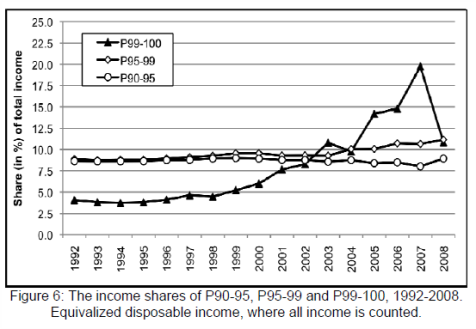
Iceland is, of course, one of the great economic disaster stories of all time. An economy that produced a decent standard of living for its people was in effect hijacked by a combination of free-market ideology and crony capitalism; one of the papers (pdf) at the conference I just attended in Luxembourg shows that the benefits of the financial bubble went overwhelmingly to a small minority at the top of the income distribution:
DESCRIPTIONOlafsson and Kristjansson
And in the process of building short-lived financial empires, a handful of operators built up enormous debts that their fellow citizens are now expected to repay.
But there’s an odd coda to the story. Unlike other disaster economies around the European periphery – economies that are trying to rehabilitate themselves through austerity and deflation — Iceland built up so much debt and found itself in such dire straits that orthodoxy was out of the question. Instead, Iceland devalued its currency massively and imposed capital controls. [ΑΥΤΗ ΕΙΝΑΙ Η ΛΥΣΙΣ ΔΙΑ ΤΗΝ ΕΛΛΑΔΑ, ΜΟΝΟΝ ΑΥΤΗ!!!]
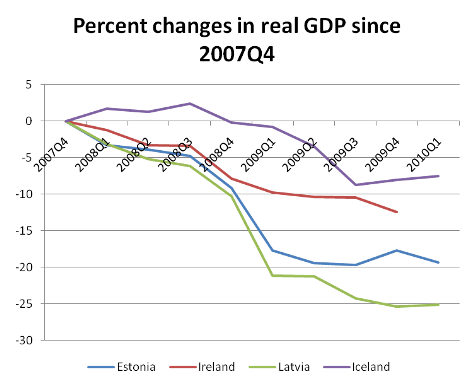
And a strange thing has happened: although Iceland is generally considered to have experienced the worst financial crisis in history, its punishment has actually been substantially less than that of other nations. Here’s GDP:
DESCRIPTIONEurostat
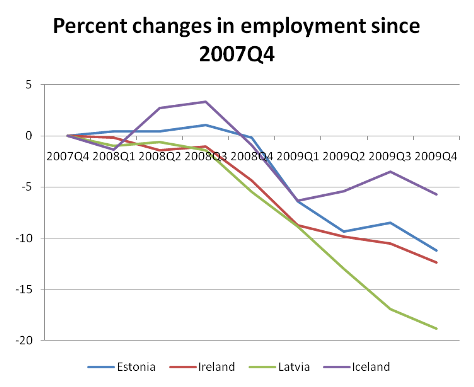
And here’s employment:
DESCRIPTIONEurostat
The moral of the story seems to be that if you’re going to have a crisis, it’s better to have a really, really bad one. Otherwise, you’ll end up taking the advice of people who assure you that even more suffering will cure what ails you.

The International Monetary Fund

June 29, 2010

Trust Them? Why?

Is Advice From the IMF Better Than Advice From a Drunk on the Street?

By DEAN BAKER
That is the question that people around the world should be asking as the International Monetary Fund dishes out its prescription for austerity. The IMF program calls for cutbacks in government support for health care, pensions and a wide range of other public services. It also calls for weakening labor market regulations that provide workers with job security.
These recommendations are being given in a context where the world economy is suffering from a massive shortfall of demand. In other words, tens of millions of people are unemployed right now because there is not enough spending to keep them employed. The IMF’s program is almost certain to reduce spending further leading to even larger shortfalls in demand and more unemployment.
But, the IMF says that we should trust them. The question we should all be asking is “why?”
Where was the IMF when the housing bubble in the United States and elsewhere was inflating to ever more dangerous levels? Was it frantically yelling at governments to rein in the bubbles before they burst with disastrous consequences? After all, what could possibly have been more important than warning of the dangers of these bubbles?
It was easy to both recognize the housing bubbles and that their collapse would have devastating consequences for the economy. Economies don’t adjust easily to a loss of wealth that in some cases exceeded 50 percent of GDP.
Real economists know this, but apparently the folks at the IMF did not, or if they did, they didn’t think it was worth saying anything. One will look in vain through IMF publications during the buildup of the housing bubble for serious warnings of the potential dangers. While the IMF can scream about the need for austerity today, it couldn’t be bothered to say much about the bubbles that got us here.
The IMF’s track record gives us reason not only to question the institution’s competence but also its motivations. This question comes up most clearly in the case of Argentina. At the end of 2001 Argentina defaulted on its debt, enraging the IMF. Prior to the default, Argentina had been an IMF poster child eagerly embracing the IMF's program. The IMF's growth forecasts clearly reflected its change of attitude towards Argentina. Prior to the default the IMF was consistently overly optimistic about Argentina's growth prospects, projecting much higher growth than Argentina actually experienced. After the default, the IMF was hugely over-pessimistic, projecting much lower growth rates than it subsequently experienced. It is difficult to explain this pattern of errors except by a political motivation.
It is possible to see a similar pattern in the IMF’s latest set of policy recommendations to deal with the economic crisis. The impact of most of its proposals will be to reduce the benefits received by ordinary workers. The proposed changes in labor market regulations will likely also weaken workers’ bargaining power, leading to cuts in wages. Furthermore, the reduction in demand caused by the turn to austerity will leave millions more out of work, both depriving these workers of income and further weakening the bargaining power of those who still have jobs.
There are alternatives. Central banks like the European Central Bank, the Bank of England and the Federal Reserve Board could just buy and hold large amounts of government debt. These central banks can both ensure that there are no questions of solvency by providing a ready market for government debt and that there is no build-up of interest burdens. The interest paid on the debt held by the banks is refunded to governments.
Large-scale central bank purchases of government debt will not create inflation in a context of massive unemployment and excess capacity. This is not a point we have to debate. Japan’s central bank has bought an amount of government debt roughly equal to its GDP, yet it remains far more concerned about deflation than inflation. While we could hope to do better on the stimulus front than Japan, inflation is simply not a problem it faces now or even on the distant horizon.
It is especially painful to see these calls from austerity coming from the IMF. This organization is distinguished not only by its dismal track record in pushing economic policies that don’t work; it also is known for the exorbitant benefits that it gives its economists. Under the IMF’s pension program, many staffers can retire in their early 50s with six-figure pensions. Imagine the folks who completely missed the housing bubble or who got it totally wrong on Argentina lounging around the tropics at age 51 on their $100,000 a year IMF pension. At least a street drunk giving economic advice would be honest.
Dean Baker is the co-director of the Center for Economic and Policy Research (CEPR). He is the author of Plunder and Blunder: The Rise and Fall of the Bubble Economy and False Profits: Recoverying From the Bubble Economy.
This column was originally published by The Guardian.