THE POSTS MOSTLY BY GEOGRAPHICAL DISTRIBUTION

THE POSTS MOSTLY BY GEOGRAPHICAL DISTRIBUTION

.

.
Boston artist Steve Mills - realistic painting

Thursday, May 4, 2017

Vijeta Uniyal : Germany Hit by Merkel's Imported Crime Wave


  • According to the Germany's annual crime report, compiled by the Federal Crime Bureau (BKA), there has been a more than 50% rise in migrant crime in the country compared to the year before.
  • They not only indulge in petty crime but have come to dominate serious and violent crime in Germany.
  • European mainstream media may keep on putting a positive spin on Merkel's "courageous" and "selfless" stance, but her policy continues to incur heavy economic, social and human cost, not only on Germany, but on the cultural future of European civilisation.
At the height of the European migrant crisis in early 2016, when masses of migrants were pouring into Europe, the German Green Party Chairwoman Katrin Göring-Eckardt could not control her joy. "We have just received an unexpected gift in the form of people," she told her fellow Germans, reminding them to be grateful. This gift, she said, was going to make the country "more religious, more colourful, more diverse and younger." It was gift, it turns out, that keeps on giving.
According to the country's annual crime report, compiled by the Federal Crime Bureau (BKA), there has been a more than 50% rise in migrant crime in the country compared to the year before.
The German newspaper Die Welt, which received an advance copy of the annual crime report, wrote:
"The number of immigrants suspected of criminal acts in 2016 has risen by 52.7 percent, to the figure of 174,438, compared to the previous year. To ensure a fair comparison with the rest of the population, crimes that only immigrants can commit, such as illegal entry to the country, have been taken out from the statistics. The annual police report (PKS) shows that there were total of 616,230 crime suspects of foreign origin last year. The migrant share [of total crime figures] was disproportionately large, namely 174,438 -- more than a quarter."
These staggering crime statistics are even more alarming if one looks through the narrow definition German government uses to denote a "criminal migrant". As Die Welt explains, these crime figures do not take into account "foreigners who have been living and working in Germany for some time, but only a specific group of protection-seekers [refugees]."
In a sane world, the government would take steps to protect its own citizens from such "protection-seekers". Not in Merkel's Germany.
What is relevant is not only what these official crime statistics reveal, but what they conceal. The actual crime share of these "protection-seekers" is much higher if one considers the fact that more than 30% of them are serial offenders and 5% of them have been booked on criminal charges at least 6 times -- a mind-boggling number given their relatively recent arrival in the country.
These new entrants make up less than 2% of the German population, but constitute 9% of Germany's criminal population. They not only indulge in petty crime but have come to dominate serious and violent crime in Germany. Nearly 15% of all suspects charged with serious bodily harm, rapes and sexual assaults come from this group, the police crime report reveals.
The German government's denial of surging migrant crime wave has led to the systemic under-reporting and suppression of information about migrant crimes. Take, for example, Berlin, where a left-wing state government keeps police chronically disarmed, even of defensive gear such as bulletproof vests, let alone firearms. The Berlin government prohibits law enforcement agencies from using video surveillance in the German capital, on the grounds of "civil rights".
To highlight the rampant lawlessness in Berlin, a TV crew from the German cable network SAT1 installed its own surveillance cameras around Berlin's well-known Kottbusser Tor no-go zone. Last year, the Berlin police registered 1,600 crimes around Kottbusser Tor. An ordinary television crew, however, managed to record hundreds of crimes in just 48 hours. According to journalist and moderator Claus Strunz:
"Our 9 cameras monitored the area [Kottbusser Tor] for 48 hours. And on the video feed -- we can't say the exact number -- but there are hundreds of crimes that would have otherwise gone undiscovered... And the parents [living in the area] say that in the year and a half since [uncontrolled migration began], they don't let their daughters walk alone on the street... either day or night."
As no act of journalistic insubordination against Merkel's "Refugees Welcome" directive goes unpunished, Claus Strunz was attacked by a journalist colleague for "politicising" his current affairs show. He was called a "populist" -- dog-whistle-talk for a far-right sympathiser -- a potentially suicidal career move for any journalist wishing to work in Germany.
Strunz was also one of the few German journalists who cared to highlight the plight of the families of the victims of the last year's Christmas market attack, in which a Tunisian Islamist migrant drove a truck loaded with 20 tons of steel beams into a busy Christmas market in Berlin. He murdered 12 people and injured 48 others.
The German mainstream media evidently decided not to personalize the stories of the Berlin terror victims. In a telling move, Merkel government categorized the victims of that attack as victims of regular "traffic accident". For Merkel and Germany's ruling establishment, apparently, the victims of migrant crimes and terror are nothing more than unfortunate roadkill on the way towards a multicultural paradise.
Rather than tackling the migrant crime wave, the Merkel government has chosen to spin the facts and bury the truth.
"Refugees aren't more criminal than Germans," a senior official from Germany's Ministry of the Interior claimed last summer. He further maintained that, according to the Ministry's calculations, "migrants hardly committed any sexual assaults and murders." That statement was made barely six months after mass sexual assaults on New Year's Eve in Cologne.
When Chancellor Merkel began her re-election bid five months ago, she described migrant crimes as "terrible isolated incidents" for which she wanted to see "tough sentencing."
So how does "tough sentencing" look like under Merkel's watch? For those New Year's Eve assaults in Cologne, where some two thousand Muslim men raped, assaulted and robbed more than 1200 women, almost all of the attackers managed to walk free. They did not even see a judge, let alone face punishment. Despite hundreds of testimonies by victims, countless reliable eyewitnesses and endless surveillance footage, the Interior Minister of North Rhine-Westphalia state, where Cologne is located, admitted that "most of the cases will remain unsolved."
With five months to go until the German elections, Merkel's government has decided to address the problem by instituting an €18 million study to probe the issues of "migration and integration."
That is just peanuts compared to what Merkel is willing to pay for her "refugee" policy. Her decision to offer asylum to more than one million migrants will cost country's taxpayers up to €1.5 trillion, according to the prominent German economist Bernd Raffelhüschen. In the best-case scenario, Raffelhüschen estimates, the cost of Germany's migrant policy will be around €878 billion. "If the second generation [of the migrants] cannot be integrated into the workforce at par with the native population, these costs will go up to €1.5 trillion," Raffelhüschen told Die Welt. Raffelhüschen's calculations, published last year, only take into account the migrant intake of 2015; they do not include any present or future migrant waves.
Germany's Federal Integration Commissioner and Merkel-confidant Aydan Özoguz is pushing for migrants to be granted voting rights similar to German citizens in any national referendum -- regardless of their legal status. According to an advisory report recently co-authored by Özoguz, "people who permanently live in a country should be able to participate in democratic decision making."
Özoguz, who helped shape Merkel's refugee policy of opening up Europe to millions of migrants from Arab and Muslim countries, with her proposal to grant voting rights to migrants, is creating a roadmap for a radical transform of Germany -- and by default that of the continental Europe

To offset the recent rise of right-wing political party, Alterative für Deutschland (AfD), the German political establishment sees the empowerment of such a vast new wave of migrants as a political counterweight.

Ever since Merkel opened Europe's borders in the spring of 2015 by arbitrarily suspending the existing EU-wide border regulations (Dublin II), Europe has been dragging itself ever deeper into a self-inflicted migrant crisis. European mainstream media may keep on putting a positive spin on Merkel's "courageous" and "selfless" stance, but her policy continues to incur heavy economic, social and human cost, not only on Germany, but on the cultural future of European civilization.
Vijeta Uniyal, a journalist and news analyst, is based in Germany.

Soeren Kern : Germany: Migrant Crime Spiked in 2016


  • Although non-Germans make up approximately 10% of the overall German population, they accounted for 30.5% of all crime suspects in the country in 2016.
  • Nearly 250,000 migrants entered the country illegally in 2016, up 61.4% from 154,188 in 2015. More than 225,000 migrants were found living in the country illegally (Unerlaubter Aufenthalt) in 2016.
  • The Berlin Senate launched an inquiry into why migrants disproportionally appear as criminals in the city-state compared to Germans.
An official annual report about crime in Germany has revealed a rapidly deteriorating security situation in the country marked by a dramatic increase in violent crime, including murder, rape and sexual assault.
The report also shows a direct link between the growing lawlessness in Germany and Chancellor Angela Merkel's decision to allow in more than one million mostly male migrants from Africa, Asia and the Middle East.
The report — Police Crime Statistics 2016 (Polizeiliche Kriminalstatistik, PKS) — was compiled by the Federal Criminal Police Office (Bundeskriminalamt, BKA) and presented by Interior Minister Thomas de Maizière in Berlin on April 24.
The number of non-German crime suspects (nichtdeutsche Tatverdächtige) legally residing in Germany jumped to 616,230 in 2016, up from 555,820 in 2015 — an increase of 11% — according to the report. Although non-Germans make up approximately 10% of the overall German population, they accounted for 30.5% of all crime suspects in the country in 2016, up from 27.6% in 2015.
In this year's report, the BKA created a separate subcategory called "migrants" (Zuwanderer) which encompasses a combination of refugees, pending asylum seekers, failed asylum seekers and illegal immigrants.
According to the BKA, the number of migrant crime suspects (tatverdächtiger Zuwanderer) in Germany in 2016 jumped to 174,438 from 114,238 in 2015 — up 52.7%. Although "migrants" made up less than 2% of the German population in 2016, they accounted for 8.6% of all crime suspects in the country — up from 5.7% in 2015.
In terms of non-German crime suspects residing legally in Germany, Turks were the primary offenders in 2016, with 69,918 suspects, followed by Romanians, Poles, Syrians, Serbs, Italians, Afghans, Bulgarians, Iraqis, Albanians, Kosovars, Moroccans, Iranians and Algerians.
In terms of migrant crime suspects, Syrians were the primary offenders, followed by Afghans, Iraqis, Albanians, Algerians, Moroccans, Serbs, Iranians, Kosovars and Somalis.

Police in Bremen, Germany frisk a North African youth who is suspected of theft. (Image source: ZDF video screenshot)
The report's other findings include:
  • Violent crime surged in Germany in 2016. These include a 14.3% increase in murder and manslaughter, a 12.7% increase in rape and sexual assault and a 9.9% increase in aggravated assault. The BKA also recorded a 14.8% increase in weapons offenses and a 7.1% increase in drug offenses.
  • Non-German crime suspects committed 2,512 rapes and sexual assaults in Germany in 2016 — an average of seven a day. Syrians were the primary offenders, followed by Afghans, Iraqis, Pakistanis, Iranians, Algerians, Moroccans, Eritreans, Nigerians and Albanians. German authorities have repeatedly been accused of underreporting the true scale of the migrant rape problem for political reasons. For example, up to 90% of the sex crimes committed in Germany in 2014 do not appear in the official statistics, according to André Schulz, the head of the Association of Criminal Police (Bund Deutscher Kriminalbeamter, BDK).
  • Non-German crime suspects committed 11,525 robberies in Germany in 2016 — an average of 32 a day. Moroccans were the primary offenders, followed by Algerians, Syrians, Georgians, Tunisians, Albanians, Afghans, Serbs, Iraqis and Iranians.
  • Non-German crime suspects committed 56,252 aggravated assaults in 2016 — an average of 154 a day. Syrians were the primary offenders, followed by Afghans, Iraqis, Iranians, Moroccans, Algerians, Somalis, Albanians, Eritreans and Pakistanis.
  • Bavaria was the German state most affected by non-German criminality, followed by North Rhine-Westphalia, Baden-Württemberg, Hesse, Berlin, Lower Saxony, Rhineland-Palatinate, Saxony, Hamburg, Schleswig-Holstein, Saxony-Anhalt, Brandenburg, Mecklenburg-Vorpommern, Saarland, Bremen and Thüringen.
  • Berlin was the German city most affected by non-German criminality, followed by Munich, Hamburg, Frankfurt, Cologne, Düsseldorf, Hanover, Stuttgart, Dortmund, Bremen, Leipzig, Nürnberg, Essen, Duisburg, Mannheim, Karlsruhe, Dresden, Freiburg im Breisgau, Chemnitz, Aachen, Bielefeld, Wuppertal, Augsburg, Bonn, Bochum, Gelsenkirchen, Wiesbaden, Münster, Kiel, Halle, Krefeld, Braunschweig, Mainz, Lübeck, Mönchengladbach, Erfurt, Oberhausen, Magdeburg and Rostock.
  • The BKA also recorded 487,711 violations of German immigration laws (ausländerrechtliche Verstöße), up 21.1% from 402,741 violations in 2015. Nearly 250,000 migrants entered the country illegally in 2016, up 61.4% from 154,188 in 2015. More than 225,000 migrants were found living in the country illegally (Unerlaubter Aufenthalt) in 2016.
The new data contradicts claims made by the BKA in December 2016 — just four months before the current report — that migrant criminality was actually decreasing.
During a press conference in Berlin on April 24, Interior Minister Thomas de Maizière admitted:
"The proportion of foreign suspects, and migrants in particular, is higher than the average for the general population. This cannot be sugarcoated. There is an overall rise in disrespect, violence and hate. Those who commit serious offenses here forfeit their right to stay here."
Separately, officials in Bavaria revealed that the number of crimes committed by asylum seekers and refugees there increased by 58% in 2016. They accounted for 9.6% of all crimes committed in the state, up from 3.2% in 2015 and 1.8% in 2012. Syrians were the primary offenders, followed by Afghans, Iraqis and Nigerians.
"The increase in crime in Bavaria in 2016 is mainly due to foreign suspects, especially immigrants," said Bavarian Interior Minister Joachim Herrmann.
At the same time, officials in Baden-Württemberg noted a 95.5% increase in the number of physical assaults involving at least one migrant in 2016.
Meanwhile, the Berlin Senate launched an inquiry into why migrants disproportionally appear as criminals in the city-state compared to Germans. In 2016, 40% of all crime suspects in the German capital were non-Germans.
None of this seems to be having an impact on the German elections set for September 24, 2017. Polls show that if the election for German chancellor were held today, Angela Merkel, who is largely responsible for the migration crisis, would be re-elected with 37% of the vote. Martin Schulz, the Social Democrat candidate who has pledged to increase migration to Germany even further, would win 29% of the vote and the anti-immigration Alternative for Germany would win 8%. For now, German voters appear to believe that the alternatives to Merkel are all worse.
Soeren Kern is a Senior Fellow at the New York-based Gatestone Institute. Follow him on Facebook and on Twitter.

Yves Mamou : France: What is the Presidential Campaign Really About?


  • The result of this mess is that France as one country no longer exists.
  • People who voted for Le Pen seem to feel not only that they lost their jobs, but that they are becoming foreigners in their own country.
  • Macron, for many analysts, is the candidate of the status quo: Islamists are not a problem and reforming the job market will supposedly solve all France's problems.
The French presidential race is the latest election to shake up establishment politics. The Parti Socialiste and Les Républicains, who have been calling the shots for the past forty years, were voted out of the race. The "remainers" are Emmanuel Macron, a clone of Canada's Prime Minster Justin Trudeau; and Marine Le Pen, whom many believe will not win.
France is a fractured country. As in the US and the UK, the rift is not between the traditional left and right. Instead, it reflects divisions -- cultural, social, and economic -- that came with globalization and mass migration. A map released by the Ministry of the Interior after the first round of the presidential campaign illustrates the new political scenery.

Blue represents the parts of France where Le Pen heads the list; pink, the areas supporting Macron. The blue areas coincide with old industrial areas, deeply damaged by globalization and industrial relocation. Many blue-collar workers are on welfare; and the antagonism between Muslims and non-Muslims is high. People who voted for Le Pen seem to feel not only that they lost their jobs, but that they are becoming foreigners in their own country.

The areas in pink (Macron), represent the big cities and places where the better jobs are. It also represents the areas where the "upper classes can afford to raise invisible barriers between themselves and the 'other', immigrants or minorities," explains Christophe Guilluy, geographer, and author of Le crépuscule de la France d'en haut (The Twilight of Elite France).

The result of this mess is that France as one country no longer exists. One half the population (in blue-collar areas, small towns and rural areas) is shut out by the other half of the population (white-collar workers) who live in the big cities.
Guilluy adds:
"The job market has become deeply polarized and mainly concentrated in big cities, squeezing out the middle classes. For the first time in history, working people no longer live in the places where jobs and wealth are created."
...
"But social issues are not the only determinant of the populist vote. Identity is also essential, linked as it is to the emergence of a multicultural society, which feeds anxiety in working-class environments. At a time of fluctuating majorities and minorities, amid demographic instability, the fear of tipping into a minority is creating considerable cultural insecurity in developed countries. Unlike the upper classes, who can afford to raise invisible barriers between themselves and the 'other' (immigrants or minorities), the working classes want a powerful state apparatus to protect them, socially and culturally. So, the populist surge is re-activating a real class vote."
The question is if frustration and anger against globalization and immigration will succeed in electing Le Pen.

This frustration was not made lighter by the abysmal level of the debate. During the presidential campaign, the media focused only on political scandals: the presumed "fake job" offenses committed by François Fillon. Week after week, other presumed "political scandals" were continually released against him by a satirical weekly, Le Canard Enchaîné.
Organized or not, these allegations overtook any discussion about the real problems in France:
 the extraordinary proportion of people on welfare, for instance. France's unemployment rate stands at 9.9% (compared to 3.9% Germany and 4.7% in Great Britain); French GDP growth is one of the weakest of eurozone (1.1% vs 1.7% for eurozone, and 1.9% for EU); and France's public debt, which accounted for 89.5% of GDP in 2012, is expected to reach 96% of GDP in 2017.

Most of all, the "French Islamist problem" remained undebated and unchanged.

 After two years of continuous terrorist attacks, after five years of continuous Muslim immigration, after dozens of Muslim riots, big and small, in the suburbs of big cities, millions of French people were expecting a change -- or at least a public conversation. But, intentionally or not, these questions were avoided by the media.

The expected victory of Emmanuel Macron -- a perfect product of the French techno-sphere -- dashes any hopes of addressing the frightening questions of Muslim immigration; Muslim no-go-zones (more than a hundred); the spread of Salafism among Muslim youths, and of the general secession of the French Muslim community.

Macron, young and modern, cautiously avoided talking about these problems. Macron, for many analysts, is the candidate of the status quo: Islamists are not a problem and reforming the job market will supposedly solve all France's problems.


French presidential candidates Emmanuel Macron (left) and Marine Le Pen. (Image source: LCI video screenshot)

The results of the first round on April 23 showed that roughly 45% of the votes cast were motivated by protest and anger against globalization and dilution of the French nation's sovereignty inside the European Union. The leftist populist Jean-Luc Mélenchon (19% of the voters) refused to endorse Macron in the runoff.
Inside Les Républicains, the big party loser of the first round, no one knows if a significant percentage might turn to Le Pen.

On May 7, more than 228 years after the French Revolution, the destiny of France may be seriously different -- and whatever the result of the presidential election, possibly not for the best.
Yves Mamou is a journalist and author based in France. He worked for two decades for the daily, Le Monde, before his retirement.

Monday, May 1, 2017

1er mai

1941, le Maréchal Philippe Pétain instaure le 1er mai comme « la fête du Travail et de la Concorde sociale »
Le 24 avril 1941, le Maréchal Philippe Pétain instaure officiellement par la loi Belin le 1er mai comme « la fête du Travail et de la Concorde sociale », appliquant ainsi la devise Travail, Famille, Patrie : par son refus à la fois du capitalisme et du socialisme, l’État français recherche une troisième voie fondée sur le corporatisme, débaptisant « la fête des travailleurs » qui faisait référence à la lutte des classes.   Le jour devient férié, chômé et payé.  Le 1er mai coïncide aussi avec la fête du saint patron du maréchal, Saint Philippe.


Patrick J. Buchanan : Is Macron the EU’s Last Best Hope?

Is Macron the EU’s Last Best Hope?


By Patrick J. Buchanan

For the French establishment, Sunday’s presidential election came close to a near-death experience. As the Duke of Wellington said of Waterloo, it was a “damn near-run thing.”
Neither candidate of the two major parties that have ruled France since Charles De Gaulle even made it into the runoff, an astonishing repudiation of France’s national elite.

Marine Le Pen of the National Front ran second with 21.5 percent of the vote. Emmanuel Macron of the new party En Marche! won 23.8 percent.
Macron is a heavy favorite on May 7. The Republicans’ Francois Fillon, who got 20 percent, and the Socialists’ Benoit Hamon, who got less than 7 percent, both have urged their supporters to save France by backing Macron.
Ominously for U.S. ties, 61 percent of French voters chose Le Pen, Fillon or radical Socialist Jean-Luc Melenchon. All favor looser ties to America and repairing relations with Vladimir Putin’s Russia.

Le Pen has a mountain to climb to win, but she is clearly the favorite of the president of Russia, and perhaps of the president of the United States. Last week, Donald Trump volunteered:
“She’s the strongest on borders, and she’s the strongest on what’s been going on in France. … Whoever is the toughest on radical Islamic terrorism, and whoever is the toughest at the borders, will do well in the election.”

As an indicator of historic trends in France, Le Pen seems likely to win twice the 18 percent her father, Jean-Marie Le Pen, won in 2002, when he lost in the runoff to Jacques Chirac.

The campaign between now and May 7, however, could make the Trump-Clinton race look like an altarpiece of democratic decorum.

Not only are the differences between the candidates stark, Le Pen has every incentive to attack to solidify her base and lay down a predicate for the future failure of a Macron government.

And Macron is vulnerable. He won because he is fresh, young, 39, and appealed to French youth as the anti-Le Pen. A personification of Robert Redford in “The Candidate.”
But he has no established party behind him to take over the government, and he is an ex-Rothschild banker in a populist environment where bankers are as welcome as hedge-fund managers at a Bernie Sanders rally.
He is a pro-EU, open-borders transnationalist who welcomes new immigrants and suggests that acts of Islamist terrorism may be the price France must pay for a multiethnic and multicultural society.
Macron was for a year economic minister to President Francois Hollande who has presided over a 10 percent unemployment rate and a growth rate that is among the most anemic in the entire European Union.
He is offering corporate tax cuts and a reduction in the size of a government that consumes 56 percent of GDP, and presents himself as the “president of patriots to face the threat of nationalists.”
His campaign is as much “us vs. them” as Le Pen’s.
And elite enthusiasm for Macron seems less rooted in any anticipation of future greatness than in the desperate hope he can save the French establishment from the dreaded prospect of Marine.
But if Macron is the present, who owns the future?
Across Europe, as in France, center-left and center-right parties that have been on the scene since World War II appear to be emptying out like dying churches. The enthusiasm and energy seem to be in the new parties of left and right, of secessionism and nationalism.
The problem for those who believe the populist movements of Europe have passed their apogee, with losses in Holland, Austria and, soon, France, that the fever has broken, is that the causes of the discontent that spawned these parties are growing stronger.

What are those causes?
A growing desire by peoples everywhere to reclaim their national sovereignty and identity, and remain who they are. And the threats to ethnic and national identity are not receding, but growing.
The tide of refugees from the Middle East and Africa has not abated. Weekly, we read of hundreds drowning in sunken boats that tried to reach Europe. Thousands make it. But the assimilation of Third World peoples in Europe is not proceeding. It seems to have halted.
Second-generation Muslims who have lived all their lives in Europe are turning up among the suicide bombers and terrorists.
Fifteen years ago, al-Qaida seemed confined to Afghanistan. Now it is all over the Middle East, as is ISIS, and calls for Islamists in Europe to murder Europeans inundate social media.
As the numbers of native-born Europeans begin to fall, with their anemic fertility rates, will the aging Europeans become more magnanimous toward destitute newcomers who do not speak the national language or assimilate into the national culture, but consume its benefits?

If a referendum were held across Europe today, asking whether the mass migrations from the former colonies of Africa and the Middle East have on balance made Europe a happier and better place to live in in recent decades, what would that secret ballot reveal?
Does Macron really represent the future of France, or is he perhaps one of the last men of yesterday?


 http://buchanan.org/blog/macron-eus-last-best-hope-126852
===================

Patrick J. Buchanan : The Rise of the Generals

The Rise of the Generals


By Patrick J. Buchanan

Has President Donald Trump outsourced foreign policy to the generals?
So it would seem. Candidate Trump held out his hand to Vladimir Putin. He rejected further U.S. intervention in Syria other than to smash ISIS.
He spoke of getting out and staying out of the misbegotten Middle East wars into which Presidents Bush II and Obama had plunged the country.
President Trump’s seeming renunciation of an anti-interventionist foreign policy is the great surprise of the first 100 days, and the most ominous. For any new war could vitiate the Trump mandate and consume his presidency.
Trump no longer calls NATO “obsolete,” but moves U.S. troops toward Russia in the Baltic and eastern Balkans. Rex Tillerson, holder of Russia’s Order of Friendship, now warns that the U.S. will not lift sanctions on Russia until she gets out of Ukraine.
If Tillerson is not bluffing, that would rule out any rapprochement in the Trump presidency. For neither Putin, nor any successor, could surrender Crimea and survive.

What happened to the Trump of 2016?
When did Kiev’s claim to Crimea become more crucial to us than a cooperative relationship with a nuclear-armed Russia? In 1991, Bush I and Secretary of State James Baker thought the very idea of Ukraine’s independence was the product of a “suicidal nationalism.”
Where do we think this demonization of Putin and ostracism of Russia is going to lead?
To get Xi Jinping to help with our Pyongyang problem, Trump has dropped all talk of befriending Taiwan, backed off Tillerson’s warning to Beijing to vacate its fortified reefs in the South China Sea, and held out promises of major concessions to Beijing in future trade deals.
“I like (Xi Jinping) and I believe he likes me a lot,” Trump said this week. One recalls FDR admonishing Churchill, “I think I can personally handle Stalin better than … your Foreign Office … Stalin hates the guts of all your people. He thinks he likes me better.”
FDR did not live to see what a fool Stalin had made of him.

Among the achievements celebrated in Trump’s first 100 days are the 59 cruise missiles launched at the Syrian airfield from which the gas attack on civilians allegedly came, and the dropping of the 22,000-pound MOAB bomb in Afghanistan.

But what did these bombings accomplish?
The War Party seems again ascendant. John McCain and Lindsey Graham are happy campers. In Afghanistan, the U.S. commander is calling for thousands more U.S. troops to assist the 8,500 still there, to stabilize an Afghan regime and army that is steadily losing ground to the Taliban.

Iran is back on the front burner. While Tillerson concedes that Tehran is in compliance with the 2015 nuclear deal, Trump says it is violating “the spirit of the agreement.”

How so? Says Tillerson, Iran is “destabilizing” the region, and threatening U.S. interests in Syria, Yemen, Iraq and Lebanon.

But Iran is an ally of Syria and was invited in to help the U.N.-recognized government put down an insurrection that contains elements of al-Qaida and ISIS. It is we, the Turks, Saudis and Gulf Arabs who have been backing the rebels seeking to overthrow the regime.

In Yemen, Houthi rebels overthrew and expelled a Saudi satrap. The bombing, blockading and intervention with troops is being done by Saudi and Sunni Arabs, assisted by the U.S. Navy and Air Force.

It is we and the Saudis who are talking of closing the Yemeni port of Hodeida, which could bring on widespread starvation.

It was not Iran, but the U.S. that invaded Iraq, overthrew the Baghdad regime and occupied the country. It was not Iran that overthrew Col. Gadhafi and created the current disaster in Libya.

Monday, the USS Mahan fired a flare to warn off an Iranian patrol boat, 1,000 meters away. Supposedly, this was a provocation. But Iranian foreign minister Javad Zarif had a point when he tweeted:
“Breaking: Our Navy operates in — yes, correct — the Persian Gulf, not the Gulf of Mexico. Question is what US Navy doing 7,500 miles from home.”

Who is behind the seeming conversion of Trump to hawk?
The generals, Bibi Netanyahu and the neocons, Congressional hawks with Cold War mindsets, the Saudi royal family and the Gulf Arabs — they are winning the battle for the president’s mind.

And their agenda for America?
We are to recognize that our true enemy in the Mideast is not al-Qaida or ISIS, but Shiite Iran and Hezbollah, Assad’s Syria and his patron, Putin. And until Hezbollah is eviscerated, Assad is gone, and Iran is smashed the way we did Afghanistan, Iraq, and Yemen, the flowering of Middle East democracy that we all seek cannot truly begin.
But before President Trump proceeds along the path laid out for him by his generals, brave and patriotic men that they are, he should discover if any of them opposed any of the idiotic wars of the last 15 years, beginning with that greatest of strategic blunders — George Bush’s invasion of Iraq.


 http://buchanan.org/blog/the-rise-of-the-generals-126882
============================

Hungary's Orban defends education law in Brussels, calling EU outrage 'absurd'


Hungary's Orban defends education law in Brussels, calling EU outrage 'absurd'

Hungary's prime minister lashed out at George Soros, founder of the embattled Central European University. The PM's remarks came after the EU Commission sent a "letter of formal notice" to the Hungarian government.


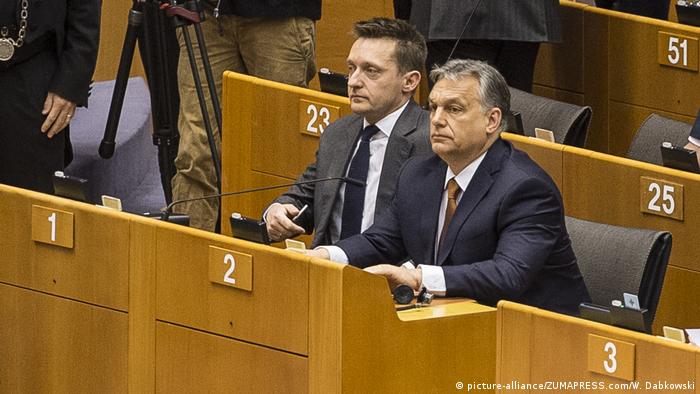
In a speech given to European parliamentarians in Brussels on Wednesday, Orban insisted Hungary remained committed to the European Union, describing his nation's membership as "not questionable" but simultaneously expressing discontent with the bloc and a desire for EU reform of its "mistakes."
The Hungarian prime minsiter's appearence in the European Parliament came hours after the European Commission began legal action against the country in light of a recently passed controversial education law perceived as targeting George Soros' Central European University (CEU).

EU launches legal action against Hungary

EU sends Orban a letter


European Commission Vice President Valdis Dombrovskis said on Wednesday that "a letter of formal notice" had been sent to Orban's government. According to Dombrovskis, the decision to begin the legal action was made after an "in-depth legal assessment" concluded the new Hungarian law allegedly breaches EU laws regarding freedoms for businesses, services and academia.
The letter is the first step of the EU's so-called infringement proceedings, whereby Brussels demands legal explanations from a member state on a particular issue. The Hungarian government has one month to respond to the letter. Brussels will then consider if any further steps are warranted. These could include referral to the European Court of Justice and possible financial penalties.

Orban criticizes EU criticism


Orban called the accusations against Hungary "absurd."
Standing before European lawmakers, Orban described the contested law as a "minor amendment" that applies to 28 universities and not just to the CEU. He described the flare-up around the law as "absurd," likening it to a pre-emptive murder conviction, given that the CEU continues to operate normally at present.
"It's almost like someone being accused of murder, then he's convicted, while the alleged victim is alive and kicking, moreover, pointing fingers at the convicted, crying: 'Murderer!'," Orban said.

Orban attacks Soros


George Soros' Central European University faces possible closure
Orban had even stronger words for CEU founder George Soros. He labeled the American-Hungarian billionare a "financial speculator" who was "attacking" Hungary.
Orban also painted Soros as detrimental to Europe as a whole, claiming Soros had "destroyed the lives of millions of Europeans with his financial speculations" and describing Soros as "an open enemy of the euro." The Hungarian leader also said the businessman wanted to open Europe's borders to millions of migrants.
Orban went on to criticize the EU for its warmth towards the billionare. On Thursday, European Commission President Jean-Claude Juncker is scheduled to meet with Soros.

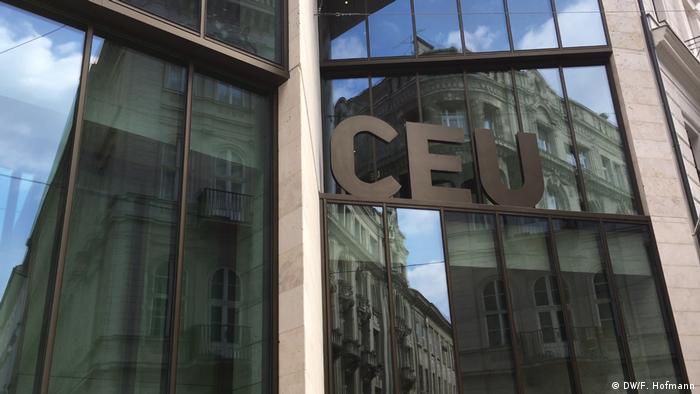
Central European University Budapest (DW/F. Hofmann) Soros' CEU lies at the center of the controversy. The Univerisity has a campus in Budapest.

CEU at the center of controversy
The EU's formal letter focuses on the law passed on April 4 that requires foreign universities operating in Hungary also have a campus in their home country. The law is seen as aimed squarely at Central European University, which has been operating in Budapest since 1993. Despite being accredited in the US state of New York, the university does not have a campus in the United States.
Orban has accused the university of maintaining an unfair advantage over other Hungarian institutions because it confers degrees that are recognized in both Hungary and the United States, However, he denied wanting to shut it down.

DW exclusive: Central European University rector, Michael Ignatieff

Critics of the right-wing head of government have decried the law, taking to the streets in protest at what they described as a targeted attack on an institution that promotes liberal values Orban is seeking to repress.
Should an agreement cease to materialize, CEU may be forced to cease enrolling new students as of January 2018.
"My institution has a gun pointed to its head," CEU President Michael Ignatieff told EU parliamentarians on Tuesday.
Showdown between Brussels and Budapest
The launch of legal action has raised the temperature on an already fiery relationship between Orban and the EU.
The EU-skeptic Orban has claimed the supranational bloc threatens Hungary's sovereignty and has launched a "Let's Stop Brussels!" questionnaire asking the opinion of Hungarian households on how to respond to alleged EU interference in Hungarian independence.
Hungarian legislation regarding systematic detention of asylum seekers and the proposed required registration of NGOs that received international funds have also drawn criticisms from the EU.

=================

Saturday, April 29, 2017

Moroccan man in Belgium pushed too far by “racism”.

Moroccan man in Belgium pushed too far by “racism”.

wgl58Qy.jpg
Buddhists do it better.
The Western world is a festering pit of racism, white supremacy, and bigotry. If you don’t believe me, then just read the Fake News Mainstream Media, or ask any Marxist humanities professor at your nearest Communist re-education centre University. They’ll confirm this is 100% accurate, without any regard for such trivialities as “evidence” or “truth”, which are racist concepts invented by white supremacists, in order to oppress “people of colour”. Unfortunately, living under this constant racism became too much for one poor Moroccan man, eventually causing him to snap under the pressure, and set himself on fire.
From Morocco World News
Saying he was “sick of racism,” a 38-year-old-man set himself on fire in the town of Kortrijk, in Belgium on Tuesday.
Ahead of the incident, the man, identified on social media as Chafik Hanchi, posted a video online. In it he declared his intent and said he was “sick of racism.”
This poor man, kidnapped from Morocco against his will, and forced to live among racist white people. If only they hadn’t taken him from his homeland, and refused him the right to return home. That must be what happened, right? If the racism he was experiencing was so terrible, he surely would have returned to his homeland willingly, if that was an option for him. He must have been a prisoner in Belgium. He couldn’t possibly have been there by his own free choice.
168774094.jpg
What kind of person would choose to leave this paradise willingly?
According to Russian-owned RT Television, on Tuesday, he left the town’s courthouse and returned some time later carrying a gasoline canister.  Stopping in a square just 15 metres from the courthouse entrance, the video shows him pouring gasoline and setting it alight.
He then pours more on to his jacket and lights that. Seconds later he is seen rushing toward fire fighters and paramedics who were already on scene. He was taken to hospital with severe burns to 35 percent of his body.
This is a really harrowing and tragic story. I actually feel sick reading it. That poor jacket didn’t deserve such a fate.
1383170743801.jpg
What a tragedy. No jacket deserves this.
Police are investigating possible motives for what they are calling an “act of desperation.”
If I was to guess, it was a publicity stunt that went too far. They literally say in the story that fire fighters were already present at the scene, before he even set himself on fire. If he really wanted to kill himself, why would he set himself on fire, while fire fighters are nearby, and then run towards them, unless he was doing so with the expectation of being saved? Sorry “Chafik”, but I reckon “Allah”, being all powerful and all knowing, can tell the difference between a genuine martyr, and a faker like you. No 72 virgins for you just yet.
According to Jamal Qnioun, head of People Help People organization and member of the Council for International Coexistence in Kortrijk, Hanchi sent him a video prior to the incident, threatening self-immolation. He also sent him a number of text messages where he talked about being “sick of racism” and that he felt he could no longer go on living.
Returning to Morocco of course wasn’t an option. He was forced to live there against his will, under this racism. Those damn Belgian people just wouldn’t let him go home, so his only option was to set himself on fire in front of fire fighters who would easily save him before he died.
e2cc435b2ef671e59a76d3d9b4ca4d3e.jpg
Clearly, not much has changed in the last 60 years or so. This poor man must have been experiencing a similar fate as this girl here.
Hanchi had been suffering immense personal street brought about by the recent lost of his father.
Probably murdered by racist white people.
He was also experiencing financial trouble.
Probably caused by racist white people.
He had, at one time, operated a hair salon in the town but was forced to shut down after inspectors discovered an undocumented employee working there.
The inspectors were probably racist white people.
According to Qnioun, Hanchi paid the fine and re-opened a new salon on the same street, only to face another inspection just days later.
So does that mean the second inspection found another violation then? It’s racist to expect this guy to pass these inspections like any other salon owner, don’t you know?
Another video, posted on a separate Facebook account, shows Hanchi complaining about trouble he was having with the national security office.
He was probably the one causing them trouble.
Again, he said he was “tired of racism.” Qnioun expressed concern on social media after the event over what he calls the “harsh conditions” faced by immigrants in Kortrijk.
So harsh… yet they continue to come to Europe by the millions. I wonder why that is?
5340551651_fbf16a2b3c
A real mystery on our hands here.
If I didn’t know better, I would guess that Europe is far superior to the countries that they originate from. But who am I to speculate? If this man says the racism is unbearable here, then we should probably just assume that it’s true, and cry about how guilty we are for having white skin. It’s the right thing to do. It’s our fault that poor jacket was lost.

 https://methodicalinsanity.wordpress.com/2017/04/20/moroccan-man-in-belgium-pushed-too-far-by-racism/
====================

Friday, April 28, 2017

Peter Baggins : The French Election: Adieu, la France


The French Election: Adieu, la France

Peter Baggins, Ph.D.


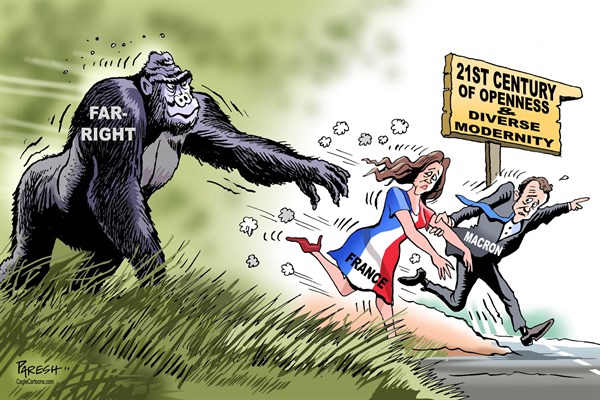
Mainstream media: Macron saving France (depicted as a White woman) by leading her to the glorious future of “openness and diverse modernity”
As anticipated by most observers, liberal globalist Emmanuel Macron and populist nationalist Marine Le Pen were selected by French voters to move on to round two in France’s presidential election, scheduled for May 7th.  For the first time in the 59-year history of the French Fifth Republic neither of the country’s two main parties, the Socialists and the Republicans, made the second round of presidential balloting. Either the socialists or the center right have run France since the 1950s, but with this election the old model has been shattered.
When the two-round system was created, it was expected that the main candidates of right and left would get around 30% in round one, and then rally satellite parties to their side for the run-off. But this time there were four candidates — with four very different versions of what to do next — all split nearly evenly at around 20%, so whoever is elected will be a minority candidate. The latest figures from the French Interior Ministry have Macron at 24%, Le Pen at 21.3%, while conservative François Fillon missed the runoff at 20%, Left-wing Jean-Luc Melenchon at 19.6% and Socialist Benoît Hamon at a paltry 6.4%.
By all accounts Macron, is likely to pick up the most votes in the runoff and will almost certainly become the next president. Marine Le Pen will fight a hard campaign, and her totals will rise, but it is almost inconceivable that she will win, according to the French and International press. Apart from this speculation, what conclusions can be drawn thus far?


First, last Sunday’s vote has shown France to be deeply divided. Four candidates with markedly different views came within a few points of one another in the vote on Sunday, suggesting that the fight about what vision of France will dominate the future is far from over.
Second, many voters are angry at current policies, including economic policies and open borders, which are seen as responsible for an endless series of terrorist attacks. For the first time ever, neither of the top two candidates represents the establishment parties. Le Pen campaigned stridently against Muslim immigration, linking it to security threats, and she may have benefited from a final surge of support after a terrorist attack in Paris two days before the election, the latest in a string of atrocities that have beset France over the past two years.
Third, the socialist left has been left in ruins. Just five years ago the Socialist party of President François Hollande achieved electoral dominance in the National Assembly and Senate as well as the Elysée palace. Benoît Hamon won the January primary vote convincingly, defeating the former prime minister, Manuel Valls but he was completely rejected by the French electorate, attracting just 6.35% of the vote.
Finally, and most importantly, the French have a real choice in the May 7 runoff, as the two remaining candidates present stark alternatives for the future of the French Republic. From an American perspective, it looks a lot like globalist Hillary-Obama squaring off against nationalist Donald Trump.
Nowhere is this stark contrast between the two more apparent than their reactions to the latest act of terrorism on French soil. As reported by The Guardian, Macron, has described terrorism as an  “imponderable problem” which will be “part of our daily lives for the years to come.”
In contrast to Macron, Le Pen had been highlighting the fact that crime and security had, in her view, been “completely absent” from the presidential campaign in a live debate just minutes before news of the Kalashnikov attack broke. “It’s a major subject that nobody has mentioned,” she complained. “We must take control of our national borders to know who is coming in. We must reorganize the intelligence services, reinforce the means at the disposal of police and gendarmes, and attack the evil at its roots — that’s to say the communitarianism and the development of Islamic fundamentalism.”
Comparing Macron vs. Le Pen
Macron, a former Goldman Sachs banker and economy minister under Hollande represents the status quo. Although he has successfully distanced himself from Hollande, he fervently believes in the EU. As the only openly Europhile candidate, he told his supporters: “We need Europe, my friends, so we will rebuild it. … I will rebuild a strong and balanced alliance, thanks to you, with Germany in order to give back Europe a real dynamic.”
Macron has praised German Chancellor Angela Merkel over her generous policy to asylum seekers that has seen more than a million new arrivals since 2015. He has pledged to speed up the review process for asylum requests to France to a maximum of six months, including appeals.
He wants to keep open borders, backs the free market, and is calling for pro-business measures such as slashing corporation taxes. He is generally supportive of international trade deals and he backs the treaty with Canada. Macron also wants a three-year suspension of housing taxes for 80 percent of French households.
Macron is Obama resurrected and clothed in an expensive and elite French suit. He has the full support of the EU establishment, the French President and Prime Minister, as well as the pledged support of several prominent candidates. Finally, a senior French Muslim leader has called on the country’s nearly 5 million Muslims to “vote massively” to make Macron president.
In contrast, Le Pen condemns the EU insisting that she would not appear before a European Union flag in an interview with the TF1 television channel.
I want to be President of the French Republic, not of the European Commission. All the more so since I consider that the European Union has done a great deal of harm to our country and to our people, be it in economic matters, in social matters, or in the matter of the disappearance of borders. This will be my first measure: to restore national borders to the French, to regain mastery in order to know who is entering our country [in order] to fight against the danger of Islamist terrorism [and] migrants [who] come and hit us in the heart.
Le Pen wants to suspend immigration, introduce new measures to curb conservative Islam and deport radical Islamists. She would curtail policies that let migrants bring relatives to France, while also making it impossible for illegal migrants to secure residency status. Foreigners convicted on terror charges or any other crime would be automatically deported, and she would abolish a law that allows children with migrant parents who are born in France to eventually become French. She would also ban the wearing of “ostentatious” religious symbols such as Muslim head scarves and veils in public, having routinely warned against the “mortal danger that is fundamentalist Islam.”

Echoing the recent campaign of Donald Trump (if not the Trumpian reality), she is for France first and rejects globalization, vowing to protect French jobs and condemning liberal policies that have left many workers struggling. Le Pen would impose a 35% tax on goods by companies that move production outside France, and would penalize groups that hire foreign workers.
Both candidates see a need for more police. Macron wants to create 10,000 more police jobs, while Le Pen wants 21,000 more police and customs officials.
A snap Ipsos survey late on Sunday suggested that Macron, who’s aiming to be the country’s youngest head of state, would win by 62% to 38% for Le Pen.
But will either candidate be capable of carrying out their programs?  Quite possibly not, because Macron has no MPs, and Marine Le Pen has only two. The new president must appoint a prime minister who can command a majority in the 577-seat National Assembly (the lower house of parliament). That could be a problem for either Macron or Le Pen, because the assembly is currently dominated by the Socialists (271 seats) and center-right Republicans (193). So to have any power to push through their proposals the next president will need their party to perform well in legislative elections on 11 and 18 June.
Then there is the judiciary to consider. A report by the leftwing BBC sums up the absurd situation facing French patriots in their courts better than any analysis I’ve seen:
A far-right French mayor has been fined 2,000 euros for inciting hatred, after declaring that there were too many Muslim children in his local schools. Robert Menard, mayor of the southern town of Beziers, is an ally of the anti-immigrant National Front party. On 1 September 2016, France’s first day back at school, he tweeted that he was witnessing the “great replacement.” The divisive term is used to describe the alleged eviction of France’s white Christian population by migrants.
On 5 September Menard said on LCI television: “In a class in the city centre of my town, 91% of the children are Muslims. Obviously, this is a problem. There are limits to tolerance.”
French law prohibits data based on people’s religious beliefs or ethnicity. Menard defended his comments, saying: “I just described the situation in my town. It is not a value judgement, it’s a fact. It’s what I can see.”
In addition to the fine, a Paris court awarded 1,000 euros (£0.85-£850; $1.1-$1,100) in court costs to anti-racist groups that had brought the case. The fine was higher than the 1,800 euros called for by the public prosecutor, who said Menard had “pointed the finger at kids, whom he describes as a weight on the national community.”
Finally there is also the media to consider. As we saw with Obama/Clinton vs. Trump, the mainstream media in France and abroad openly favor the liberals and show hostile contempt for conservatives. The account above by the BBC is obviously riddled with biased and pejorative phrasing. Here’s another sample of the BBC’s bias with respect to the two candidates.
On Macron:
“And yet somehow Emmanuel Macron read the zeitgeist. He found an untapped reservoir of support among the young, the disillusioned-but-optimistic, the anti-cynics. Through his energy, his youth, and his incomparable charm and articulacy, he has pulled off a political coup that will go down in the annals.”
On LePen:
Bernard Cazeneuve, the sitting Socialist prime minister, called Ms. Le Pen’s project “dangerous and sectarian” and said it would “impoverish, isolate and divide” the country. “It will inevitably lead to the end of Europe and of the euro, and, eventually, to France’s relegation,” he said. “The National Front cannot be the future of our country.”
From French mainstream media:
Macron : «Je veux être le président des patriotes face à la menace des nationalistes» (“I want to be the president of the patriots facing the threat of the nationalists”).
From the EU:
The EU’s unelected executive is quietly terrified that a Le Pen presidency could bring the European project to a screeching halt. “From the [European] Commission’s point of view, success for Marine Le Pen is a disaster and an existential threat to the European project,” an anonymous high-ranking official confessed in March 2017. “We can survive a Brexit, but not a Frexit.”
Like Trump, Le Pen must appeal directly to the people, bypassing a largely hostile media. Having watched both Trump and Le Pen campaign rallies I am struck by their similarities — hard-hitting direct speech before large enthusiastic crowds. In front of her cheering supporters, Le Pen declared that she embodies “the great alternative” for French voters. She portrayed her duel with Macron as a battle between “patriots” and “wild deregulation” — warning of job losses overseas, mass migration straining resources at home and “the free circulation of terrorists.”
“The time has come to free the French people,” she said at her election day headquarters, adding that nothing short of “the survival of France” will be at stake in the presidential runoff.
As election results were being broadcast, French police detained 29 people in Paris after “anti-fascist” demonstrators became violent — hurling glass bottles and firecrackers and setting cars ablaze. The left-wing protesters said they were angry that far-right leader Marine Le Pen is advancing to the French presidential runoff. Like the antifa in the US, they prefer violence to voting. Six officers and three demonstrators were injured during the protests at the Place de la Bastille and several businesses sustained damage (Agence-France Presse).
The day after the election Macron came under fire for acting as if victory next month was already his. Macron’s visit to a chic Left Bank brasserie on Sunday night after his first round triumph handed ammunition to his opponents who described it as shallow, arrogant behavior. “They were patting themselves on the back with the whole celeb crew,” Le Pen remarked while visiting a wholesale market near Paris on Tuesday. “It shows that this arrogant cast thinks it’s already won and can do what it wants with the country.”
Surveying the dismal French political landscape following the election, James Delingpole writing for Breitbart news had this pessimistic comment:
While many French — and pretty much all the global commentariat — appear to have made up their minds that they have just dodged a bullet because they are not, after all, going to end up with a Presidency in the hands of the “far right”, they really have very little to celebrate. All France has done is to guarantee the election of a lame-duck caretaker president — Continuation Hollande — who will ensure that France’s ongoing decline will continue unabated. Its industries will stagnate; its social unrest will intensify; ever greater numbers of its citizenry will be murdered in homegrown terrorist attacks; its economy will tank; the country that was once arguably the most civilised and beautiful and sophisticated in all the world will descend ever deeper into chaos, ugliness, and despair.
Salut, President Macron. Adieu, la France.
Over the next two weeks “The great debate will finally take place,” Ms. Le Pen said on Twitter. “French citizens need to seize this historic opportunity.”
But will they?


 http://www.theoccidentalobserver.net/2017/04/the-french-election-adieu-la-france/#more-151799
==================

Wednesday, April 19, 2017

Alan M. Dershowitz : What North Korea Should Teach Us about Iran


We failed to prevent North Korea from developing nuclear weapons. As a result, our options to stop them from developing a delivery system capable of reaching our shores are severely limited.
The hard lesson from our failure to stop North Korea before they became a nuclear power is that we MUST stop Iran from ever developing or acquiring a nuclear arsenal. A nuclear Iran would be far more dangerous to American interests than a nuclear North Korea. Iran already has missiles capable of reaching numerous American allies. They are in the process of upgrading them and making them capable of delivering a nuclear payload to our shores. Its fundamentalist religious leaders would be willing to sacrifice millions of Iranians to destroy the "Big Satan" (United States) or the "Little Satan" (Israel). The late "moderate" leader Hashemi Rafsanjani once told an American journalist that if Iran attacked Israel with nuclear weapons, they "would kill as many as five million Jews," and that if Israel retaliated, they would kill fifteen million Iranians, which would be "a small sacrifice from among the billion Muslims in the world." He concluded that "it is not irrational to contemplate such an eventuality." Recall that the Iranian mullahs were willing to sacrifice thousands of "child-soldiers" in their futile war with Iraq. There is nothing more dangerous than a "suicide regime" armed with nuclear weapons.
The deal signed by Iran in 2015 postpones Iran's quest for a nuclear arsenal, but it doesn't prevent it, despite Iran's unequivocal statement in the preamble to the agreement that "Iran reaffirms that under no circumstances will Iran ever seek, develop or acquire nuclear weapons." (Emphasis added). Recall that North Korea provided similar assurances to the Clinton Administration back in 1994, only to break them several years later -- with no real consequences. The Iranian mullahs apparently regard their reaffirmation as merely hortatory and not legally binding. The body of the agreement itself -- the portion Iran believes is legally binding -- does not preclude Iran from developing nuclear weapons after a certain time, variously estimated as between 10 to 15 years from the signing of the agreement. Nor does it prevent Iran from perfecting its delivery systems, including nuclear tipped inter-continental ballistic missiles capable of reaching the United States.


If we are not to make the same mistake with Iran that we made with North Korea, we must do something now – before Iran secures a weapon – to deter the mullahs from becoming a nuclear power, over which we would have little or no leverage.
Congress should now enact legislation declaring that Iran's reaffirmation that it will never "develop or acquire nuclear weapons" is an integral part of the agreement and represents the policy of the United States. It is too late to change the words of the deal, but it is not too late for Congress to insist that Iran comply fully with all of its provisions, even those in the preamble.
In order to ensure that the entirety of the agreement is carried out, including that reaffirmation, Congress should adopt the proposal made by Thomas L. Friedman on 22 July 2015 and by myself on 5 September 2013. To quote Friedman:
"Congress should pass a resolution authorizing this and future presidents to use force to prevent Iran from ever becoming a nuclear weapons state ... Iran must know now that the U.S. president is authorized to destroy – without warning or negotiation – any attempt by Tehran to build a bomb."
I put it similarly: Congress should authorize the President "to take military action against Iran's nuclear weapon's program if it were to cross the red lines...."
The benefits of enacting such legislation are clear: the law would underline the centrality to the deal of Iran's reaffirmation never to acquire nuclear weapons, and would provide both a deterrent against Iran violating its reaffirmation and an enforcement authorization in the event it does.
A law based on these two elements -- adopting Iran's reaffirmation as the official American policy and authorizing a preventive military strike if Iran tried to obtain nuclear weapons -- may be an alternative we can live with. But without such an alternative, the deal as currently interpreted by Iran will not prevent Iran from obtaining nuclear weapons. In all probability, it would merely postpone that catastrophe for about a decade while legitimating its occurrence. This is not an outcome we can live with, as evidenced by the crisis we are now confronting with North Korea. So let us learn from our mistake and not repeat it with Iran.
Alan M. Dershowitz, Felix Frankfurter Professor of Law, Emeritus, at Harvard Law School and author of Taking the Stand: My Life in the Law and Electile Dysfunction: A Guide for the Unaroused Voter.
  • Follow Alan M. Dershowitz on Twitter
=================