March 1. More than 4,000 millionaires emigrated from Germany in 2016,
compared to 1,000 millionaires who left the country in 2015,
according
to the 2017 Global Wealth Migration Review. Before the migration crisis
erupted in 2015, millionaires were leaving Germany at the rate of only a
few hundred per year. Most of Germany's millionaires, citing
deteriorating security, left for Australia, Canada, the United States,
Dubai and Israel. The mass exodus of wealth is hollowing out Germany's
tax base at a time when the German government is spending tens of
billions of euros for the upkeep of millions of refugees and migrants
from the Muslim world. The report's editor, Andrew Amoils,
warned
that the wealthy are a kind of early warning system for society. Due to
their financial status, education and international contacts, they can
emigrate more easily than others. Over the longer term, however, their
exodus portends increased emigration from among the middle class,
according to the report.
March 2. A 36-year-old Syrian migrant identified only as Abdalfatah H. A. was
arrested
in Düsseldorf on charges of murdering 36 people in March 2013 in Syria
in the name of the Al-Nusra jihadist group. He arrived in Germany with
his pregnant wife and three children, aged three, five and seven, in
October 2015. He had been collecting €2,400 ($2,600) a month in social
welfare benefits since April 2016.
March 2. Administrators of the Johannes Rau Gymnasium, a secondary school in Wuppertal,
asked
teachers to prohibit Muslim pupils from engaging in "provocative
praying" in public. An internal memo stated: "In recent weeks, it has
been increasingly observed that Muslim pupils in the school building are
praying, clearly visible to others, signaled by ritual washings in the
toilets, the rolling out of prayer mats, and taking up certain postures.
This is not permitted."
March 3. An 18-year-old asylum seeker from Somalia was
charged
with murdering an 87-year-old woman at a retirement home in Neuenhaus.
Police said the accused entered the facility through an unlocked back
door with the aim of having sexual intercourse with elderly residents.
He sexually assaulted a 59-year-old paralytic, entered an adjacent room
and sexually assaulted an 87-year-old man. He then beat the man's wife,
who was sleeping in the same room. The woman died from her injuries. The
accused is being housed in a psychiatric hospital.
March 4. Spiegel Online
reported
that more than 900 people, including many women, have left Germany to
join the Islamic State in Iraq and Syria. Roughly one-third have
returned to Germany, while another 145 are believed to have been killed
in battle. A state prosecutor warned that the returnees are especially
dangerous: "They often have had extreme experiences of violence, are
strongly radicalized and have few prospects in Germany."
March 7. The German-language version of the ISIS magazine
Rumiyah called
on lone wolf jihadists to kill "apostate" imams in Germany and Austria.
An article entitled, "Kill the Infidel Imams in Germany and Austria,"
specifically mentioned the following "apostate" imams: Aiman Mazyek,
Secretary-General of the Central Council of Muslims in Germany; Abdul
Adhim Kamouss, an imam in Berlin of Moroccan origin; Hesham Shashaa, an
imam at the Darul Quran mosque in Munich; and Omar Al-Rawi, a Vienna
city councilman.
March 9. A 37-year-old migrant from Kosovo, identified only as Fatmir H., was
arrested after he injured nine people, including two police officers, with an axe at the central train station in Düsseldorf. Police
said Fatmir H. suffers from paranoid schizophrenia and was in an "exceptional mental state" at the time of the attack.
March 10. An unidentified man brandishing a machete
attacked
an 80-year-old man in the Kalkum district of Düsseldorf. The
perpetrator remains at large. In Hamburg, six people were injured when
two youths with tear gas
attacked a train carrying 50 people. The perpetrators remain at large.
March 10. Germany spent more than €23 billion ($25 billion) on the
reception, accommodation and care of migrants and refugees in 2016,
according to Bundestag Vice President Johannes Singhammer. The average annual
cost per migrant
was approximately €11,800 ($13,000). In Berlin alone, the actual amount
of money spent on migrants was twice as much as initially budgeted:
€1.27 billion rather than €685 million.
March 10. The Bundesrat, the upper chamber of the German parliament,
rejected
a law that would have fast-tracked deportations to Algeria, Morocco and
Tunisia by classifying those states as "safe countries of origin." The
German Constitution
defines
safe countries as countries "in which, on the basis of their laws,
enforcement practices and general political conditions, it can be safely
concluded that neither political persecution nor inhuman or degrading
punishment or treatment exists." The decision, led by federal states
with left-leaning governing coalitions, means that criminal migrants
from the Maghreb will indefinitely remain in Germany.
March 11. Police in Essen
foiled
a jihadist attack on a shopping center at the Limbecker Platz. Essen
Police Chief Frank Richter said he had received "very concrete
indications" on the plot to attack the facility, which has more than 200
stores and an average of 60,000 visitors on any given Saturday. Police
arrested two Salafists from Oberhausen, including one who had fought for
the Islamic State in Syria.
March 12. The number of crimes committed by asylum seekers and
refugees in Baden-Württemberg increased significantly in 2016.
Statistics
showed
a total of 251,000 criminal suspects, of whom 107,417 were non-Germans,
mostly from Turkey, Romania and Italy. Of the non-German criminals,
25,379 were asylum seekers and refugees (up from 18,695 in 2015). They
committed 64,329 crimes in 2016, an increase of nearly 20% over 2015.
Syrians were the most frequent offenders 4,053 (2015: 1,253), followed
by Gambians 2,346 (2015: 1,592) and Afghans 1,934 (2015: 638). The
number of suspects from Kosovo fell from 1,531 to 1,094 and Serbs from
1,488 to 1,224. Criminals from those two countries were increasingly
being deported in 2016. Police noted a 95.5% increase in the number of
physical assaults involving at least one migrant, to 7,670 cases in
2016.
March 13. The number of crimes committed by asylum seekers and refugees in Bavaria increased significantly in 2016. Statistics
showed
a total of 274,633 criminal suspects of whom 180,023 were Germans
(+0.3%) and 94,610 were non-Germans (+14.9%). Of the non-German
criminals, 26,332 were asylum seekers and refugees, an increase of 57.8%
compared to the previous year. The proportion of migrant suspects to
all suspects was 9.6%, an increase of 3.2% (in 2012 the share was 1.8%).
Among the migrant suspects, Syrians were the most frequent offenders at
16.1% (2015: 11.1%), followed by Afghans with 14.3% (2015: 10.1%),
Iraqis with 8.8% (2015: 4.6%) and Nigerians with 6.8% (2015: 5.4%). "The
increase in crime in Bavaria in 2016 is mainly due to foreign suspects,
especially immigrants," said Bavarian Interior Minister Joachim
Herrmann.
March 14. A migrant from Kosovo who has lived in Germany for 28 years
and is an active member of the hardline Islamic Salafist movement
demanded
that the Meierfeld secondary school in Herford provide his ninth-grade
son with a prayer room "so that he can perform the Friday prayer on time
and without disturbance." The man also prohibited his son from
attending music lessons, which he said are banned by Islam. Previously,
the man
demanded that the Friedenstal secondary school, also in Herford, provide a prayer room for another of his sons.
March 14. More than 400 police and counter-terrorism officers
raided
a mosque in Hildesheim. The Interior Minister of Lower Saxony, Boris
Pistorius, said the Deutschsprachigen Islamkreis Hildesheim (DIK) was a
"hotspot of the radical Salafist scene" and ordered it closed because it
was "indoctrinating Muslims to go to Iraq and Syria."
March 14. A 17-year-old Somali migrant
raped a 43-year-old woman at a train station in Bamberg. A "southerner" (
südländischer Typ)
raped a 14-year-old girl at a playground in Döbeln.
March 15. A 40-year-old German man of Turkish descent
stabbed to death
his 34-year-old wife in front of a child daycare center in Kiel.
Neighbors said the couple, who were separated, had quarreled about
moving their children to Turkey.
March 16. Prosecutors in Gelsenkirchen
charged
a 23-year-old German man of Turkish origin, identified only as Anil O.,
with membership in a terrorist organization for joining the Islamic
State in Syria. He traveled to Syria in August 2015 to work as a medic
but, according to prosecutors, he became disillusioned with the Islamic
State. Upon his return to Germany, he was arrested.
March 17. A ten-year-old asylum seeker from Afghanistan
sexually assaulted
a 75-year-old woman in Tyrol (Austria). Police said they believe he has
committed at least five other offenses of the same kind.
March 17. German immigration authorities are
testing
software that will be able to recognize the dialect of migrants to
determine whether they are legitimate asylum seekers. Some 60% of
migrants who have arrived in Germany since 2015 do not have
identification documents. "The idea is to record speech samples from
asylum seekers and carry out an automatic dialect analysis," said Julian
Detzel of the Office for Migration and Refugees (BAMF).
March 18. Five Arab migrants were
accused of gang raping a seven-year-old girl at a refugee reception shelter in the Bahrenfeld district of Hamburg.
March 19. Two Syrian asylum seekers, aged 17 and 23,
stabbed two female passersby in broad daylight in the pedestrian zone of Dessau-Roßlau.
March 21. Two North African asylum seekers were charged with
attempted manslaughter after they pushed a 40-year-old man onto the
tracks of an oncoming train at the station in Dresden-Zschachwitz. The
conductor brought the train to a halt a few meters from the man, who was
prevented from getting back onto the platform by the perpetrators, a
23-year-old Moroccan and a 27-year-old Libyan. Chief Prosecutor Lorenz
Haase initially dropped charges against the men,
concluding that there was "no evidence" of murderous intent. Haase
reversed his decision on day later after a nationwide outpouring of anger.
March 21. Three Muslim teenagers were
handed sentences
of between six and seven years in prison for the April 16, 2016 bombing
of a Sikh temple in Essen. The judge ruled that the motive for the
attack, in which three people were injured, was hatred of other
religions. The three were members of the hardline Islamic Salafist
movement.
March 22. The German Press Council (
Presserat)
loosened its guidelines (
Pressekodex)
for reporting crimes. Journalists are now allowed to provide
information about the ethnic or religious background of suspects or
perpetrators of crimes if there is a "justified public interest" to do
so. Previously, journalists were only allowed to provide such details if
it was absolutely necessary (
begründeter Sachbezug) to
understand the reported event. The change followed complaints from
German media outlets that the old guidelines were difficult to
interpret.
March 23. The Mannheim Labor Court
rejected
a lawsuit filed by a 40-year-old Muslim nurse who claimed that she was
unfairly terminated after only one week by a nursing home because she
refused to wash male patients. The woman, who has been living in Germany
for three years, told the court that she wants to integrate into German
society but does not understand why her former employer could not
accept that her religion forbids her to wash men. The court ruled that
the employer was entitled to dismiss employees during the six-month
period of probation.
March 23. The Interior Minister of Hesse
ordered
a "permanent ban" the Al-Madina Mosque in Kassel for promoting
Salafi-jihadism and for "exchanging and inviting hatred and violence
against other religious groups, states and peoples, as well as generally
differently thinking people."
March 23. The number of prisoners in the state of Baden-Württemberg has
increased
by 615 to 7,400 since 2015, and all 17 of the state's prisons are
overcrowded. The reason for the increase in the number of inmates is the
influx of migrants: The proportion of foreigners among the prison
population increased from 39% to 46% in the last two years alone,
according to the
Stuttgarter Nachrichten.
March 24. The Berlin Police Department
announced
the creation of a special task force to investigate acid attacks. At
least six women in the city have been attacked with acid since the
beginning of 2017. The latest attack occurred on March 14, when a
41-year-old pedestrian was attacked by an unknown cyclist in Prenzlauer
Berg district of the capital.
March 24. A 31-year-old Afghan migrant brandishing a hammer
attacked
a 59-year-old man riding a bicycle in the Bergedorf district of
Hamburg. Police said the attacker, who was found soaked in his victim's
blood, was "psychologically ill."
March 24. A 30-year-old man
shouting
"Allahu Akhbar" and "you are all going to die" forced the temporary
closure of the central bus station in Bamberg. Police said the man
showed "clear signs of mental illness." They added that an arrest
warrant was not issued due to his illness.
March 24. A 36-year-old Tunisian jihadist
evaded deportation
by requesting asylum in Germany. Haykel S., who was arrested during a
counter-terrorism raid in Frankfurt on February 1, was already on the
commercial airplane that was to fly him to Tunis when the Frankfurt
administrative court ordered that he be allowed to remain in Germany.
Haykel S. first arrived in Germany in 2003 on a student visa. Due to his
subsequent marriage to a German, he was granted residency. He later
returned to Tunisia and then returned to Germany in August 2015. Since
then, he has repeatedly been arrested for criminal activity.
March 25. A North Rhine-Westphalia police report leaked to
Bild am Sonntag revealed
that police knew as early as March 2016 that Anis Amri, the 31-year-old
Tunisian who carried out the December 19 jihadist attack on the
Christmas market in Berlin, was planning an attack, but he was not
deported because he did not have a passport. The report stated: "Amri
presents a threat in the form of a suicide attack. The commission of a
terrorist attack by Amri is expected."
March 27. The
Süddeutsche Zeitung reported
that Turkey's National Intelligence Agency had provided Germany's BND
intelligence service with a list of names of hundreds of alleged
followers of the Islamic Gülen movement in Germany. The movement is led
by Turkish preacher Fethullah Gülen, who has lived in the United States
since 1999. Turkish President Recep Tayyip Erdogan has blamed Gülen for
the failed military coup in July 2016. The list, which includes
addresses, telephone numbers and photographs of those concerned, proved
that the Turkish government has been secretly spying on persons,
associations, schools and other institutions linked to Gülen in Germany.
March 28. Humboldt University of Berlin
announced
it will open an Islamic theology institute. The objective of the
program is "to impart academic foundations in Islamic theology for
training imams and to qualify students for a school teaching post."
Humboldt University will become the sixth university in Germany to teach
Islamic theology. Berlin Mayor Michael Müller
revealed
that the institute is being paid for by German taxpayers: €13.5 million
($14.5 million) of government funding will secure the institute's
finances through 2022. Humboldt University President Sabine Kunst
rejected
calls for a joint "Faculty for Theology" for Christians, Muslims and
Jews: "The first step is to set up the Institute for Islamic Theology at
the HU. We want this to be a success. It is important that this key
project is not overloaded by a much broader idea."
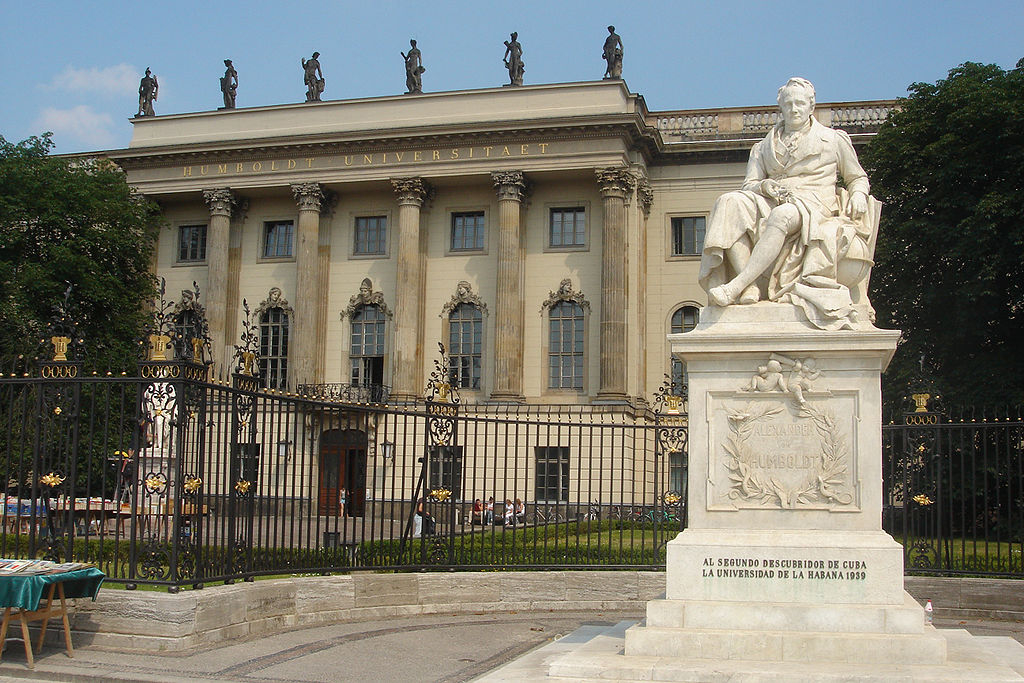
Humboldt
University of Berlin has announced that it will open an Islamic
theology institute. It will be the sixth university in Germany to teach
Islamic theology. (Image source: Friedrich Petersdorff/Wikimedia
Commons)
|
March 30. Jens Spahn, a member of the executive committee of Chancellor Angela Merkel's Christian Democrats (CDU),
called
for an Islam Law to regulate the practice of Islam in Germany. He
demanded German language tests for imams, saying that many of the
preachers who delivered sermons in German mosques come from abroad,
cannot speak German and are paid by other countries. Spahn also said
that mosques should be registered, saying that authorities "did not know
how many mosques there are in Germany, where they are or who finances
them." In addition, Spahn, called for the training of imams, teachers of
religion and counselors to be paid for with tax money. "What is clear,"
he said, "is that the financing of mosques by foreign actors must
stop."
Soeren Kern is a Senior Fellow at the New York-based Gatestone Institute. Follow him on Facebook and on Twitter.